Quick Answer
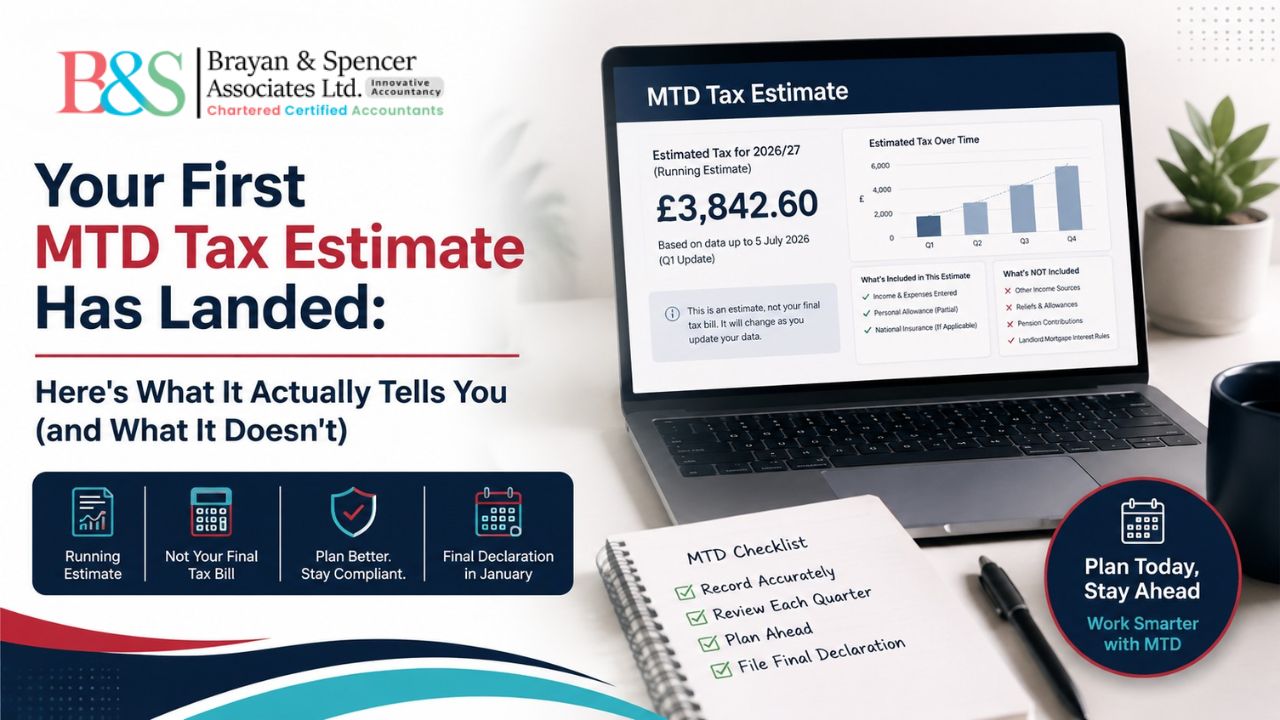
After you submit your first Making Tax Digital Income Tax quarterly update, your software shows an estimated tax bill based on the figures entered so far. This is a running forecast, not a final calculation. It does not yet account for your personal allowance in full, other income sources, reliefs like pension contributions, or, for landlords, the restriction on mortgage interest relief. Treat it as a planning tool that becomes more accurate for each quarter, not a number to bank on until your Final Declaration in January.
You’ve Filed. Now There’s a Number on Screen. What Is It?
If you were one of the 864,000-plus sole traders and landlords who submitted a first Making Tax Digital for Income Tax update ahead of the 7 August 2026 deadline, you’ve probably already seen it: a figure appears in your software estimating what you owe HMRC. For many people, this is the first time they’ve seen anything resembling a tax bill outside of January, and it naturally raises a question nobody’s software answers on screen: is this number real?
The short answer is that it’s real in the sense that it’s calculated from your actual data. It is not real in the sense of being your final liability. Understanding the gap between those two things matters, particularly if you’re a landlord, have more than one income source, or the number that appeared surprised you in either direction.
This follows on from our coverage of HMRC’s announcement on the first quarterly deadline, where we noted that the running tax estimate was arguably the most practically useful feature buried in HMRC’s press release. This piece goes into exactly how to read it.
What the Estimate Is Actually Built From
Each time you submit a quarterly update, your software takes up the cumulative income and expense totals you’ve entered for the tax year so far and runs them through a simplified tax calculation. After Q1, that means figures for 6 April to 5 July 2026 only. The estimate effectively asks: if your income and expenses continued at this rate for the rest of the year, what would you likely owe?
It uses your basic Income Tax bands and, in most software, applies to your personal allowance and National Insurance position where that data is available. What it cannot do is account for anything HMRC doesn’t yet know about, because you haven’t told it yet.
Why It Is Not Your Final Tax Bill
There are several reasons the number on screen after Q1 will differ, sometimes significantly, from what you owe by 31 January 2027.
It only reflects one quarter of the data, extrapolated.
Income and expenses rarely land evenly across the year. A sole trader with a quiet April and a busy June will see a distorted early estimate. Landlords with seasonal void periods or one-off maintenance costs in a single quarter will see the same effect.
Other income sources may not be included.
If you have employment income taxed through PAYE, dividend income, savings interest, or a second self-employment or property business reported separately, your software may not be pulling all of that into the estimate unless it has been told about it.
Reliefs and allowances are often incomplete.
Pension contributions, Gift Aid, marriage allowance transfers, and certain other reliefs are typically finalised at year-end through your Final Declaration, not captured automatically in a quarterly estimate.
It is based entirely on what you’ve entered.
If April’s receipts are still sitting in a shoebox rather than logged in your software, the estimate is calculating from incomplete expense data, which almost always means it overstates what you owe. Under-recorded expenses are the single most common reason a first quarter estimate looks worse than reality.
The Landlord Trap: Mortgage Interest and the 20% Credit
This is the detail we see catch out more London landlords than anything else, and it’s worth explaining properly rather than in passing.
Since the phased changes brought in under Section 24, mortgage interest and other finance costs on residential rental property are not deducted from your rental income as an expense in the way letting agent fees or repairs are. Instead, you get a tax credit worth 20% of the finance cost, applied after your tax has been calculated.
Here’s why that matters for your quarterly estimate: if your software’s estimate treats mortgage interest as a straightforward deduction, or if the finance cost hasn’t been entered in the correct category, your Q1 estimate can be meaningfully wrong, usually too low, because the true tax impact of a higher-rate landlord’s mortgage interest is smaller than a simple deduction would suggest. Landlords in the higher or additional rate bands feel this most, since the 20% credit is worth proportionally less to them than the relief they would have received under the old rules.
If you have a mortgage on a rental property, it is worth checking specifically that your software has categorised finance costs correctly, and not assuming the on-screen estimate has handled the Section 24 restriction the way HMRC’s own calculation will.
Making the Estimate More Useful Each Quarter
The good news is that the forecast genuinely improves as the year goes on. By the time you’ve submitted Q2 (due 7 November, covering 5 October) and Q3 (due 7 February, covering 5 January), the estimate is working from three-quarters of real data rather than one, and seasonal distortions start to even out.
A few habits make the number more reliable from the start:
- Categorise expenses as you go, not in the days before each deadline, so the estimate reflects your actual costs rather than a partial picture.
- Flag other income sources to your software or your accountant early, rather than waiting for the Final Declaration to mention them.
- Check finance cost entries for rental property specifically, given the Section 24 treatment described above.
- Don’t adjust your behaviour based on Q1 alone. One quarter is a data point, not a trend.
How to Actually Use the Number
Used correctly, the running estimate is genuinely valuable, particularly for cash flow. Rather than discovering a large bill in January with no warning, you get four checkpoints across the year to set up money aside. This is especially useful if you make payments on account, since a running estimate that’s trending meaningfully higher than expected is a useful early signal to review whether your payments on account for 2026/27 need adjusting, rather than waiting to find out in January.
If the number looks alarming, the first step isn’t panic, it’s a quick review: are all your expenses logged, is other income missing, and for landlords, has mortgage interest been categorised correctly. Most surprising estimates come down to one of those three things.
Where This Fits with the Rest of Your MTD Year
Getting comfortable reading this figure now sets you up for the remaining quarters. For the full deadline calendar and what’s still ahead this tax year, see our guide to the MTD quarterly deadline for 2026/27, and if you want the detail on what is and isn’t covered by HMRC’s first-year soft landing on penalties, our breakdown of MTD penalty rules for 2026/27 is worth a read alongside this one. You can also browse our full Making Tax Digital blog category for everything else in the series.
How Brayan & Spencer Associates Can Help
A quarterly tax estimate is a useful tool, but it’s not a substitute for a proper review, particularly if you’re a landlord with mortgaged property, you have income from more than one source, or the figure on screen doesn’t match what you expected. We help London sole traders and landlords check that their quarterly figures, and the estimates built from them, reflect their real position, not just what’s been entered into the software so far.
Call 0207 183 5956 or visit www.bsassociate.co.uk if you would like your Q1 estimate reviewed before you plan around it or want support getting Q2 right from the start.
Frequently Asked Questions
HMRC-recognised software calculates a running estimate of your tax bill using the income and expense figures submitted so far, giving you an early indication of your position rather than waiting until your January Self-Assessment deadline.
No. It is a forecast based on partial-year data and does not automatically include all reliefs, allowances, or other income sources. Your actual liability is confirmed through your End of Period Statement and Final Declaration.
The most common cause is mortgage interest and other finance costs not being reflected correctly. Since these costs only qualify for a 20% tax credit rather than a full deduction, the estimate can be distorted if this hasn’t been categorised properly in your software.
Yes. Each quarterly update adds more real data, so estimates based on two, three, or four quarters are generally more reliable than a single quarter, which can be skewed by seasonal income or one-off expenses.
It’s worth reviewing, particularly if the estimate is trending significantly higher or lower than expected, but this is a decision worth checking with an accountant rather than adjusting payments on account from a single quarter figure alone.
Check three things first: whether all expenses for the quarter have been entered, whether other income sources are reflected, and, for landlords, whether mortgage interest has been categorised correctly. Most unexpected figures trace back to one of these.