Quick answer: If you are a sole trader or landlord earning over £50,000 and your accountant has not raised making tax digital penalty points with you unprompted, that is a genuine warning sign, not a minor oversight. It is one of the clearest, most current tests of whether an accountant and tax specialist is managing your affairs or just processing paperwork once a year.
Here is a test that costs nothing and takes thirty seconds. Think back over the last few months. Has your accountant mentioned making tax digital penalty points to you, without you having to ask first?
If the answer is yes, good. That is what proactive tax advice in the London market should look like. If the answer is no, and you fall under MTD for Income Tax, it is worth asking why not, because HMRC has quietly built a system that punishes silence.
Why This Specific Test Matters Right Now
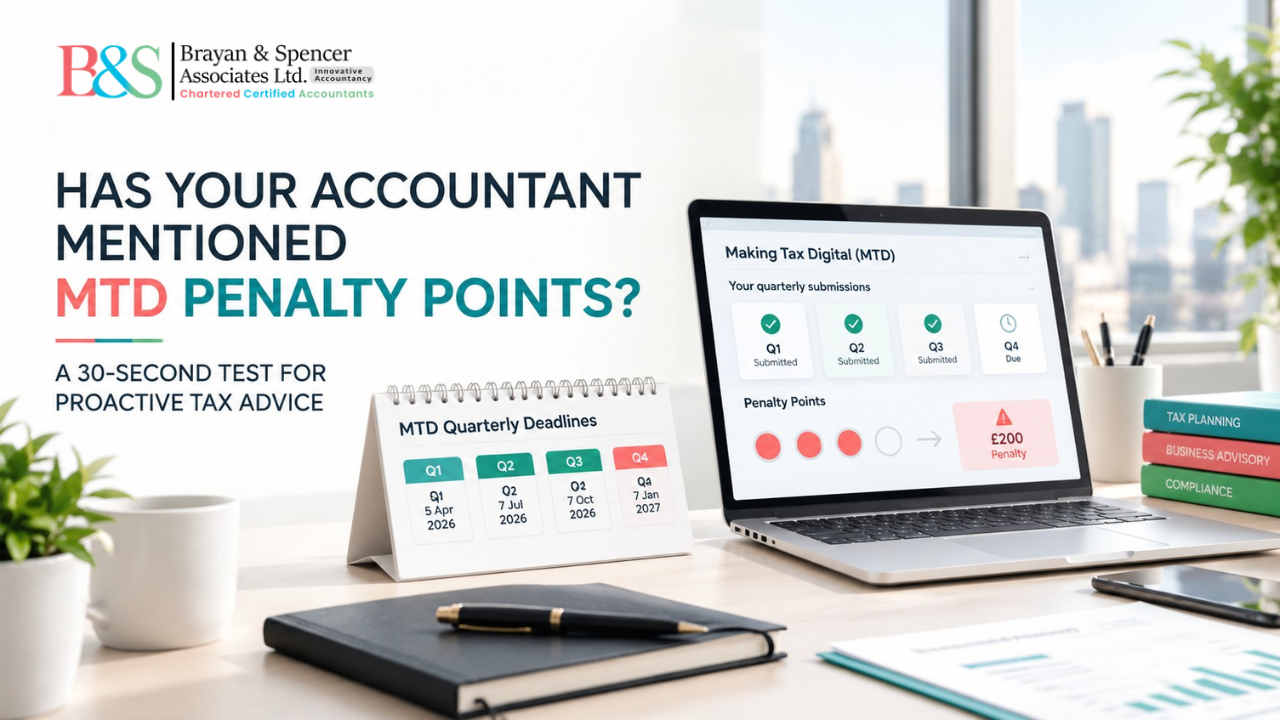
Since 6 April 2026, sole traders and landlords with combined income over £50,000 have been required to file quarterly digital updates under making tax digital for Income Tax, rather than one annual self assessment return. HMRC replaced the old flat late-filing fine with a points-based system: miss a quarterly deadline and you pick up a penalty point. Reach four points as a quarterly filer, and a £200 fixed penalty lands, with another £200 for every missed deadline after that.
HMRC has built in a soft landing for the first four quarterly updates in 2026/27, so points are not being issued for those specific submissions yet. But that grace period is temporary, late payment penalties and interest still apply in the meantime, and the points system becomes fully live once the soft landing ends. We covered exactly how the maths works in our breakdown of what a late MTD update actually costs, and what the second quarterly deadline on 7 November means in our MTD September sign-up guide.
If HMRC has already written to you about a missed deadline or an inconsistency in your filings, our guide on handling an HMRC letter about undeclared income or our dedicated HMRC Tax Enquiry support page are worth reading before you respond.
This is exactly the kind of change a genuinely engaged accountant flags before it becomes a problem, not after.
What a Reactive Accountant Actually Costs You
The uncomfortable truth is that most business owners do not lose money to one big accounting mistake. They lose it in small, avoidable amounts that compound over the year: a quarterly update filed a few days late here, an unclaimed allowance there, a VAT question answered too slowly to act on.
None of these show up as a dramatic failure. They show up as a slightly higher tax bill than it needed to be, and a filing history that HMRC quietly notices even if you do not. An accountant who only makes contact when a deadline is already close is, by definition, working reactively rather than protecting you in advance.
What Good Tax Advisers in London Actually Do Differently
A capable Tax Advisers in London team should be doing a handful of things without being chased for them:
- Telling you in advance which HMRC deadlines apply to your specific situation, not a generic list
- Flagging regulatory changes like MTD as soon as they affect you, not after a letter arrives
- Giving you a clear, written breakdown of fees rather than vague hourly billing
- Responding to questions within a reasonable timeframe, with a named point of contact
- Understanding the specific tax position of your sector, whether that is property, healthcare, hospitality, or professional services
This is the practical difference between a firm offering basic Accounting Services in London and one that positions itself as a genuine tax advisory partner. The paperwork looks the same either way. The outcome for your tax bill and your stress levels does not.
A Faster Way to Judge Your Current Setup
Rather than working through a long checklist, ask yourself three direct questions:
Has your accountant contacted you about something before you had to ask about it in the last three months? If the honest answer is no, the relationship has likely drifted into purely reactive mode.
Do you understand exactly what you are paying for each month? If fees feel opaque, that is often a sign of a wider communication gap, not just a billing issue.
Could you name one thing your accountant has proactively saved you, in time or money, this year? If nothing comes to mind immediately, it may be worth a second opinion from an established Accountants and Tax Advisers in London firm.
These three questions tend to surface the same issues a long red-flag list would, just faster and with less guesswork.
What Full-Service Tax Advisers in London Should Cover
A properly resourced accounting and tax practice in London typically brings the following together under one team, rather than leaving you to coordinate separate providers:
- Taxation planning and compliance for both personal and corporate tax
- Statutory and Management Accounts prepared to Companies House standards
- Payroll Services, including auto-enrolment and RTI reporting
- Company Secretarial support for statutory filings and registers
- Audit Assurance & Services where a statutory or voluntary audit applies
- Ongoing MTD compliance support, including quarterly digital submissions
If your current provider handles only one or two of these, you may already be paying separately for services that a single Accountant And Tax Specialist team could manage together, with far less risk of anything falling through the gap between two providers.
What This Actually Costs
Fees vary by structure and complexity, but current UK market pricing generally sits within these ranges:
- Sole traders: roughly £50 to £150 per month for MTD-compliant bookkeeping and self assessment support
- Small limited companies: roughly £100 to £300 per month, covering accounts, Corporation Tax, and payroll where needed
- VAT-registered or higher-volume businesses: typically £150 to £400+ per month, depending on transaction volume
London costs tend to sit slightly above the national average, largely reflecting the complexity of the businesses based here. The more useful comparison is not the monthly fee on its own, but whether that fee buys you proactive tax advice in the London market or just an annual filing service.
Where Brayan & Spencer Associates Fits In
At Brayan and Spencer Associates, our team of Accountants and Tax Advisers in London builds MTD deadlines, penalty tracking, and quarterly compliance directly into how we manage client accounts, rather than treating it as a once-a-year conversation. As a firm registered as auditors with the ACCA, we work with sole traders, landlords, contractors, and limited companies across London who want a team that raises issues before they become penalties.
If you want a second opinion on where your current accounting setup stands, our Accountant And Tax Specialist team can review it with you directly, and our Accounting & Tax Services page sets out the full range of support available.
Get in touch through www.bsassociate.co.uk, visit our Contact Us page, or call 0207 183 5956 for a straightforward conversation about your current position.
Frequently Asked Questions
You receive one penalty point. Once quarterly filers reach four points, HMRC issues a £200 fixed penalty, and a further £200 applies for every subsequent missed deadline while you remain at the threshold. A soft landing currently applies to the first four quarterly updates for those newly mandated in 2026/27, but late payment penalties and interest still apply separately.
From April 2026, it applies to sole traders and landlords with combined gross income from self-employment and property over £50,000 in the 2024/25 tax year. The threshold drops to £30,000 in April 2027 and £20,000 in April 2028, bringing more people into scope over time.
The previous system charged an automatic £100 fine for a late annual return. MTD replaces this with a points-based system tied to quarterly submissions, designed to penalise repeated lateness rather than a single missed deadline.
Not on its own, but if MTD has not come up in conversation with your current accountant despite applying to you, it is a reasonable prompt to ask more direct questions about how proactively they are managing your account. You will find more general answers on our FAQ page.
For most sole traders, MTD-compliant bookkeeping and quarterly filing support falls within the same £50 to £150 monthly range as standard Self Assessment support, though this can vary depending on transaction volume and software requirements.