If HMRC has recently written to tell you that you’re now signed up for Making Tax Digital for Income Tax, you’re not alone and you’re not necessarily behind. But there’s a deadline sitting just weeks away that catches a lot of people out: 7 November 2026, the second quarterly update.
Whether you signed up yourself back in the spring, or HMRC has just enrolled you as part of its September sign-up drive, the question is the same: what exactly do you need to do before that date?
Quick Answer
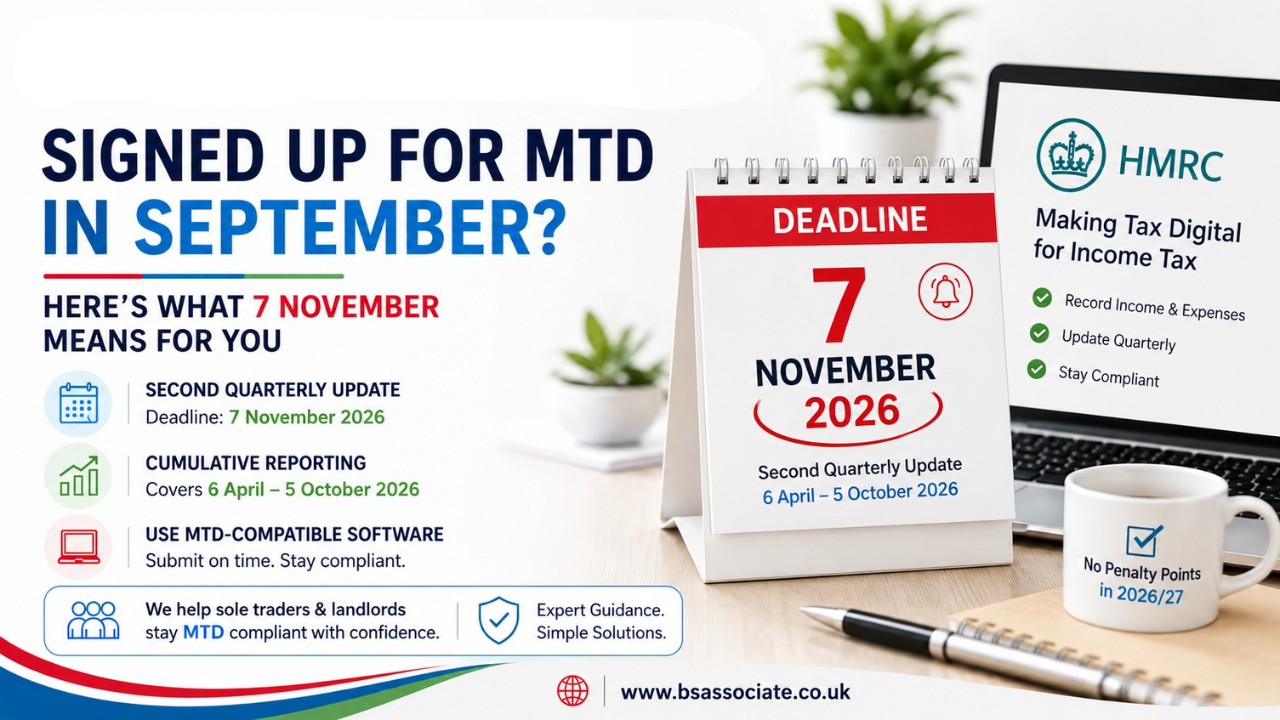
If you’re within Making Tax Digital for Income Tax, your second quarterly update is due by 7 November 2026. It covers everything from 6 April to 5 October 2026 not just the last three months, but a cumulative total for the whole tax year so far. If you already submitted your first update in August, you simply add the next period’s figures. If you were signed up more recently and missed the 7 August deadline, you’ll need to submit the outstanding first update through MTD-compatible software before, or alongside, your second one. There are no penalty points for late quarterly updates in the 2026 to 2027 tax year, but the updates still must go in, and late tax returns and late payments are penalised as normal.
What HMRC’s September Sign-Up Actually Changed
From September 2026, HMRC began signing up sole traders and landlords who needed to use Making Tax Digital for Income Tax for the 2026/27 tax year but hadn’t registered themselves. This applies where HMRC’s records show qualifying income over £50,000 in the 2024/25 tax year. We’ve covered what HMRC’s September sign-up wave means in detail elsewhere, but the short version bears repeating here: being signed up by HMRC puts you into the system. It does not set up your software, digitise your past records, or file anything on your behalf. Those steps are still yours to complete.
If you’d rather get ahead of it, you can still sign up for Making Tax Digital yourself rather than waiting to be contacted, which gives you more control over timing and software choice.
Understanding the Second Quarterly Update
This is where a lot of confusion sets in. Each quarterly update under Making Tax Digital is cumulative, not a standalone three-month snapshot. The second update, due 7 November 2026, reports your income and expenses for the whole period from 6 April to 5 October meaning it effectively includes everything from your first update plus the next quarter’s activity.
In practical terms, this matters for two reasons:
- If your first update contained an error, the cumulative structure gives you a natural point to correct the running total in the next submission, rather than trying to resubmit a closed period.
- If you’re catching up after being signed up late, your software will typically need the full 6 April to 5 October picture in one go, not just the most recent slice.
Table: 2026/27 Quarterly Update Periods and Deadlines
| Update | Period covered | Deadline |
| First | 6 April – 5 July 2026 | 7 August 2026 |
| Second | 6 April – 5 October 2026 | 7 November 2026 |
| Third | 6 April – 5 January 2027 | 7 February 2027 |
| Fourth | 6 April – 5 April 2027 | 7 May 2027 |
Some taxpayers use calendar quarter periods instead of these standard dates. If that applies to you, your software will show your actual dates to check before assuming the table above applies.
If You Missed the 7 August Deadline
You’re not the only one, and you’re not automatically penalised. HMRC has confirmed no penalty points apply to late quarterly updates during the first year of MTD for Income Tax (2026/27). But two things still matter:
- The obligation doesn’t disappear. You still need to submit the outstanding first update, and all quarterly updates for the year must eventually be filed before you can submit your year-end tax return.
- Penalty points do start applying from the second year onwards, and separately, late self – assessment returns and late payments carry their own penalties regardless of the soft landing on quarterly updates. Our article on how MTD penalty points actually work explains the mechanics if you want the detail.
If you’ve only just been signed up by HMRC and the August deadline has already passed, the practical route is straightforward: get compatible software connected, pull together your records for 6 April onward, and submit the missed update as soon as you can ideally before, or alongside, your second update. We’ve written more on what happens if you missed the August deadline if this applies to you.
What You Actually Need to Do Before 7 November
- Confirm that you’re signed up. Check your HMRC online account or your software for confirmation, whether you registered yourself or HMRC did it for you.
- Check your software is connected and compatible. HMRC does not provide MTD software, you need a product from its published list of compatible software, linked to your HMRC account.
- Bring your digital records up to date to 5 October 2026. This means income and expenses recorded digitally, not on paper or in a standalone spreadsheet without bridging software.
- Submit any outstanding first update, if you haven’t already.
- Submit the second update itself through your software before 7 November.
- Check the tax estimate your software generates. This is a running forecast, useful for planning, but not your final tax bill.
- Keep going. The third update (to 5 January 2027) and fourth (to 5 April 2027) follow on the same cumulative basis.
What If Your Circumstances Have Changed?
If your self-employment or property income has stopped, started, or changed significantly since you were assessed for MTD, this doesn’t automatically remove or add the obligation mid-year your position for 2026/27 was generally set based on your 2024/25 qualifying income. If you believe your circumstances mean MTD shouldn’t apply to you, or you think you may qualify for an exemption (for example, on digital exclusion grounds), that needs to go through HMRC’s formal channels rather than simply stopping your updates. It’s worth getting this checked properly rather than guessing.
Landlords: A Few Extra Points
If you’re a landlord with more than one property, or you share rental income with someone else, your quarterly figures need to reflect the correct split and cover each property income source appropriately. Joint ownership arrangements and multiple lets add a layer of complexity that’s easy to get wrong in a rushed submission. If this sounds like your situation, our property tax accounting service is worth a conversation before your next deadline lands.
Do You Need an Accountant for This?
Not everyone does. If your records are already digital, your software is connected, and your first update went smoothly, you may well be comfortable handling the second one yourself. Where professional support tends to help most is if you’re catching up after a late sign-up, juggling multiple income sources, or simply want someone checking the figures before they go to HMRC. Our bookkeeping support can take the digital record-keeping off your hands entirely, and our Self Assessment service picks up the year-end tax return once your quarterly updates are complete.
FAQ
It’s the second of four updates required under MTD for Income Tax, due by 7 November 2026. It covers cumulative income and expenses from 6 April to 5 October 2026, not just the three months since your first update.
Yes. Being signed up later than 7 August doesn’t remove the obligation to report that period. You’ll need to submit the outstanding first update through compatible software, ideally before or alongside your second update.
No penalty points apply to late quarterly updates during the 2026/27 tax year. However, the update still needs to be filed, and separate penalties apply for late self – assessment returns and late tax payments.
No. Quarterly updates are running summaries of income and expenses. Your final tax position is confirmed through your year-end self – assessment tax return, still due by 31 January.
No. Each update is cumulative, reporting everything from 6 April up to that quarter’s end date. The second update includes your first quarter’s figures plus the next three months.