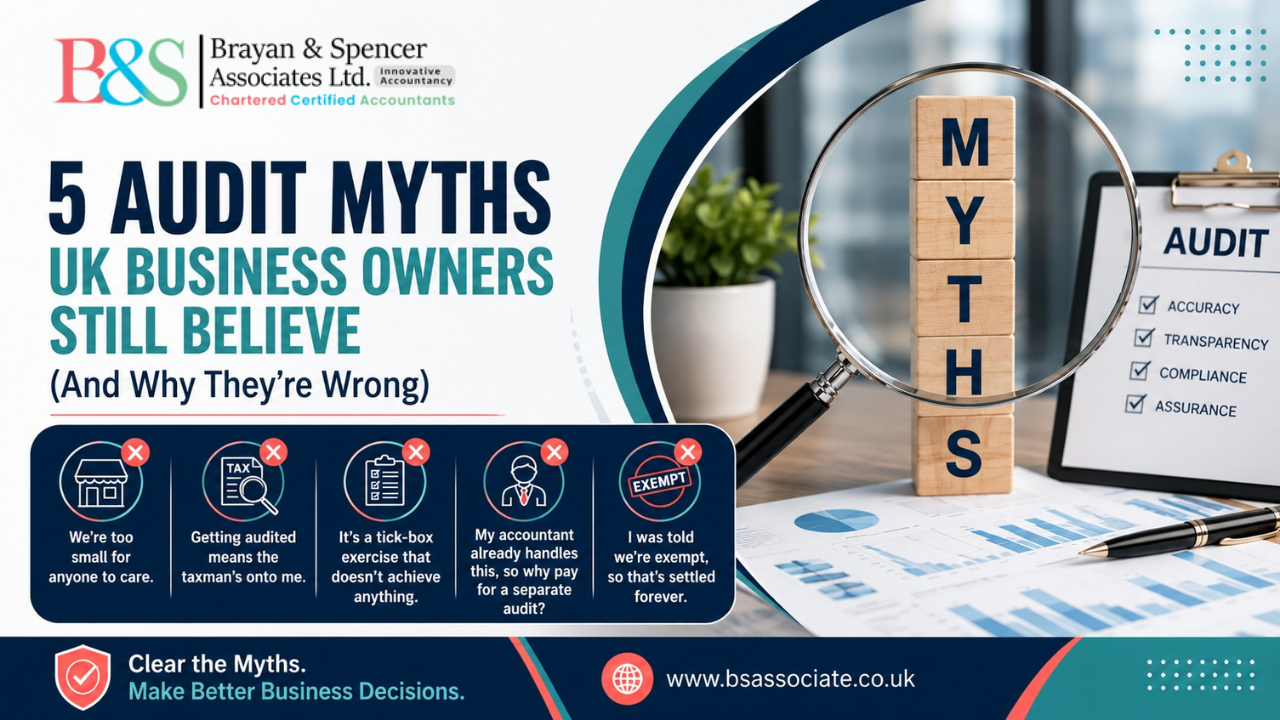
“We’re too small for anyone to care.” “Getting audited means HMRC’s onto you.” “My accountants already got this covered.” Sound familiar? If you’ve said, or believed, any of these, you’ve been carrying around an audit myth that could be quietly costing your business money, and you’re not the only one.
Here’s the thing: none of it’s malicious. This is the kind of “advice” that gets repeated at trade shows, in group chats, and over a pint, delivered with total confidence by someone who’s never actually needed an audit in their life. But believe the wrong one, and it can talk you out of a voluntary audit that would’ve helped you land funding or make you write off the whole process as pointless box-ticking right before it flags something that saves you real money.
So let’s put five of the most common ones to the test. As one of the established Audit Assurance & Services providers working with businesses across the UK, here’s what we hear most often from clients at Brayan & Spencer Associates, and what’s true underneath each claim.
My Business Is Too Small for Anyone to Care About an Audit
There’s a grain of truth buried in here, since audit requirements genuinely scale with company size. But size determining whether you must have an audit says nothing about whether you’d benefit from one.
A surprising number of smaller, fast-growing businesses arrange a voluntary audit purely because it opens doors. Banks weighing up a loan, investors deciding whether to back you, or a larger client sizing you up before signing a multi-year contract, all of them tend to trust audited figures more than unaudited ones, regardless of what the law technically demands. Ruling out a statutory audit UK requirement purely on the basis of “we’re too small” can quietly close off funding or contracts you’d otherwise have a shot at.
Getting Audited Means the Taxman’s Onto Me
This one refuses to die, and it’s built on a mix-up between two completely different things. A financial audit checks whether your accounts fairly represent your business. An HMRC compliance check or investigation is HMRC specifically reviewing your tax position. They’re not the same process, run by different people, for entirely different reasons.
If anything, the relationship runs the opposite way to what people assume. Accounts that have already been through a proper independent audit are easier to defend if HMRC ever does come knocking, because someone’s already gone through them with a fine-tooth comb. It’s also worth remembering that your taxation position and your audit are handled as separate pieces of work, even when the same firm looks after both. An audit isn’t a warning sign. It’s closer to having your paperwork already sorted before anyone asks for it.
It’s a Tick-Box Exercise That Doesn’t Actually Achieve Anything
People who believe this have usually sat through a rushed, minimal audit somewhere and assumed that’s just what audits are. It isn’t, and it’s exactly the gap we built our approach to close. A properly run audit under our financial audit services goes well beyond confirming the numbers add up. It should be surfacing real issues, cash quietly disappearing through inefficient processes, weak spots in your controls, or reporting habits that could be tightened.
The same logic applies to internal audit services. Done properly, an internal audit is a deliberate hunt for the small operational cracks that eventually turn into expensive problems if nobody catches them early. If your experience felt pointless, that’s a reflection of the firm you used, not a fair verdict on what audits are capable of.
My Accountant Already Handles This, So Why Pay for a Separate Audit?
This confusion comes up constantly, and it’s genuinely easy to see why. Your accountant looks after your bookkeeping, prepares your accounts, and manages your tax affairs day to day. An audit is a different kind of check entirely, carried out by someone who had no hand in preparing those figures in the first place.
That separation exists for a reason. If the person reviewing your numbers is the same person who put them together, you haven’t got an independent check, you’ve got one perspective evaluating itself. Real assurance depends on a genuinely separate set of eyes, which is precisely why audit work and everyday accountancy stay as distinct roles, even inside the same firm.
I Was Told We’re Exempt, So That’s Settled Forever
Exemption isn’t a status you earn once and keep for life. It gets reassessed against your turnover, your balance sheet, and your headcount, and all three can move as your business grows, shrinks, or changes shape through a restructure or acquisition. A company comfortably exempt two years back could easily have crossed back into audit territory by now, without anyone noticing.
This is one of the quieter ways businesses trip up, simply because nobody thinks to check again once the original answer felt settled. If your numbers have shifted meaningfully, through growth, a merger, or bringing new entities into a group, it’s worth revisiting your position alongside your statutory and management accounts and company secretarial filings, rather than running on an answer that might be a couple of years out of date.
The Common Thread Behind All Five
Notice that each of these myths pushes in the same direction: towards doing less checking, asking fewer questions, and assuming last year’s answer still holds. Sometimes that costs you funding you could have secured. Sometimes it means missing insight that would have actually helped your business. And sometimes it means filing accounts under a status you’re no longer entitled to, without realising it.
None of these are dramatic mistakes on their own. They’re small, quiet assumptions that compound over time. The fix isn’t complicated though: swap the assumption for an actual conversation with a properly established Audit Assurance & Services Provider in UK, one that deals with exactly this, every day.
Brayan & Spencer Associates: A Leading Audit Assurance & Services Provider in the UK
Brayan & Spencer Associates is a leading Audit Assurance & Services Provider in the UK, and every myth above is one we spend time actively correcting for our clients, not just writing about. We’ve built our reputation on giving businesses a genuinely comprehensive range of audit and assurance support, not a one-size-fits-all package.
Our financial audit services assess the accuracy and completeness of your company’s financial statements, flag areas of financial risk, and give you clear, practical recommendations for improvement. We carry out financial audits for businesses of all sizes, keeping you aligned with accounting standards and regulatory requirements as they evolve.
Our internal audit services evaluate your internal controls and processes, making sure they’re effective and efficient, and helping to reduce the risk of fraud, errors, and other financial irregularities. We build internal audit programmes around your business, not a generic checklist.
Beyond that, we provide broader assurance services covering sustainability reporting, risk management, and regulatory compliance, helping you develop strategies that work for your business. The rules around audit and assurance keep shifting, and regulators expect more transparency and accuracy than ever. We believe it’s our job to help build trust in your reporting while reducing risk and giving you a clearer, more precise view of your business.
Our team works closely alongside our Accountancy Firm London and Accountants and Tax Advisers services, so your audit, your tax position, and your day-to-day accounting all work together properly. You can see the full breadth of what we offer on our Audit Assurance & Services page, and if you want to check where your business currently stands on exemption, our guide on current UK audit thresholds walks you through it.
Not Sure Which of These Applies to You?
Whether you’re wondering if a voluntary audit could help you secure funding, or you just want someone to confirm your exemption status is still accurate, we’re happy to talk it through, no jargon, no pressure.
Call us on 0207 183 5956 Or visit www.bsassociate.co.uk Or get in touch online
Frequently Asked Questions
No. A financial audit is independent of verification of your accounts, separate from an HMRC compliance check or tax investigation. Well-audited accounts can actually make things easier if HMRC does ever have questions.
Yes, often. Many small and growing businesses choose a voluntary audit to build credibility with lenders, investors, or larger customers, even when they’re not legally required to have one.
Not for the same set of accounts they prepared. Auditors need to be independent of the figures they’re checking, which is why audit and accountancy work are kept as separate services, even within the same firm.
No. Your exemption status is reassessed based on your turnover, balance sheet, and employee numbers each year, so it’s worth checking your position annually rather than assuming it hasn’t changed.
Brayan & Spencer Associates offers tailored Audit Assurance & Services for UK businesses of all sizes. Call 0207 183 5956 or visit www.bsassociate.co.uk to speak with our team.