Quick answer: CQC registration and ongoing compliance depend on financial evidence just as much as clinical policy. A specialist healthcare accountant helps care providers demonstrate financial viability at registration, navigate VAT rules specific to welfare services, and keep the statutory accounts and governance records that feed directly into CQC’s Well-led assessment. Brayan & Spencer Associates provides support for health and adult social care providers across London.
In more than ten years working as a healthcare accountant in London, I’ve sat across the table from a lot of nervous care business owners. Some are weeks away from submitting their first CQC application, convinced they’ve missed something. Others are established providers staring down an upcoming assessment, wondering whether their books will hold up to the scrutiny. The pattern I keep seeing is this: the businesses that struggle with CQC are rarely the ones providing poor care. They’re the ones whose finances were never built to support the story their care actually tells.
That gap is exactly why I do this job, and exactly why Brayan & Spencer Associates exists as more than a general accountancy firm. We work specifically with health and adult social care providers across London, because this sector doesn’t run generic bookkeeping. It runs on financial evidence that stands up to a regulator, VAT rules that trip even experienced operators, and a level of scrutiny most small businesses never have to think about. If you run a care home, a domiciliary care agency, a GP practice, a clinic, or a supported living service, this is written for you.
Why CQC Registration Needs an Accountant, Not Just a Consultant
Most providers preparing to register with the Care Quality Commission focus, quite reasonably, on policies, procedures, staffing plans, and the interview with their nominated individual. What surprises a lot of people is that CQC also wants to see that your business can survive long enough to become a stable, safe service. That’s a financial question, not a clinical one, and it’s the part of the application that gets rushed or skipped entirely when a care provider hasn’t brought an accountant into the process early.
In practice, this means demonstrating:
- Realistic cash flow forecasts covering the period before your client base and fee income build up
- Evidence of working capital or funding, so CQC can see you’re not one bad month away from cutting corners on staffing or safety
- A statement of purpose backed by numbers, not just good intentions
- Properly maintained statutory accounts and governance records, if you’re registering as an organisation rather than an individual
I’ve seen strong, well-run care services get delayed at registration purely because the financial evidence was an afterthought, bolted on the week before submission. It’s one of the most avoidable mistakes in the whole process, and it’s exactly where a healthcare accountant earns their fee.
Five CQC Financial Mistakes I See Again and Again
Most of the financial trouble I’m asked to untangle traces back to one of these five habits. If any of them sound familiar, it’s worth a proper review before CQC gets there first.
- Treating the financial viability section as a formality. Cash flow forecasts are written to satisfy the form, not to reflect what the business will need in its first year.
- Assuming VAT exemption means no VAT costs at all. Exempt care fees still leave irrecoverable VAT sitting on refurbishment, equipment, and agency staff.
- Letting statutory filings slip once registration is granted. Registration feels like the finish line, so company secretarial deadlines quietly drift.
- Running payroll without factoring in sleep-in shifts and National Minimum Wage complexity. A common, costly, and entirely avoidable error in care staffing.
- Waiting for an inspection to tidy up the books. By then, it’s too late to fix anything, only to explain it.
What CQC Actually Wants to See From Your Books
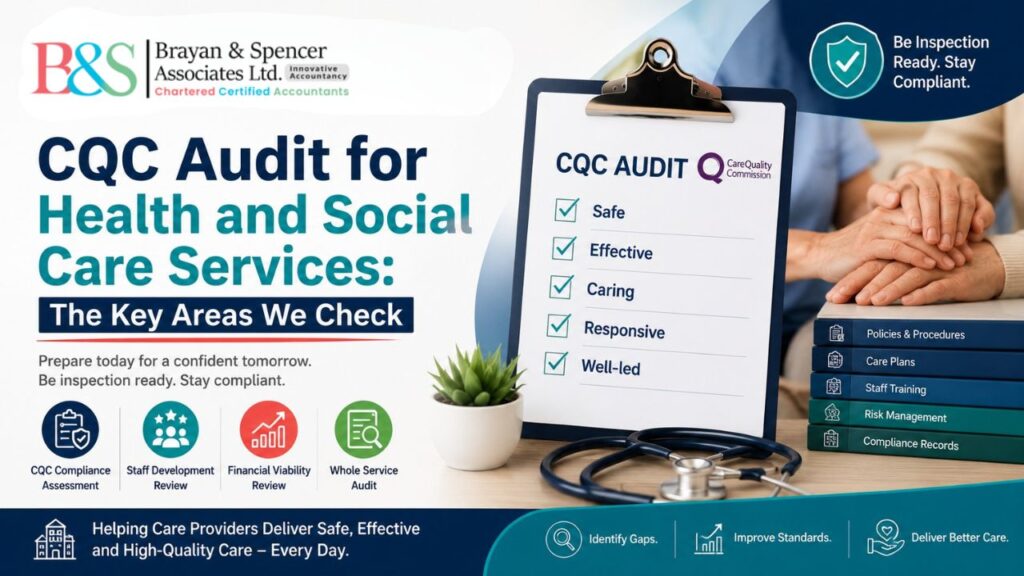
CQC’s assessment framework is built around five key questions that apply to every regulated service; whatever changes happen to the wider framework around them: Safe, Effective, Caring, Responsive, and Well-led. The one most closely tied to your finances is Well-led, and it goes far beyond a single interview.
Under continuous assessment, CQC draws on ongoing evidence throughout your registration, not just a one-off inspection. That includes statutory notifications, workforce data, and yes, your financial performance. A provider with inconsistent bookkeeping, late statutory accounts, or lapsed company secretarial filings is quietly building risk into their Well-led evidence long before an assessor ever asks a direct question about money.
This is where our work as accountants for medical professionals and social care providers sits alongside, not instead of, your compliance advisor. Policies tell CQC what you intend to do. Your accounts tell CQC whether you can.
The VAT Trap That Catches Even Experienced Care Providers
If there’s one area where I see genuinely good operators lose money unnecessarily, it’s VAT. Most CQC-registered care providers know their care fees are VAT exempt under welfare services rules, and that’s correct. What fewer providers realise is that exemption isn’t a saving; it’s a trade-off. You don’t charge VAT on your fees, but you also can’t reclaim VAT on your own costs: refurbishment, equipment, professional fees, and agency staff all carry VAT you simply absorb.
On a significant refurbishment or a new location, that irrecoverable VAT can run into tens of thousands of pounds if it isn’t planned for in advance. I’ve had conversations with care homeowners who only discovered this after the invoice landed, when a proper VAT review before the project would have let them budget for it, or in some cases structure the spend more efficiently. This is exactly the kind of specialist knowledge that separates healthcare accounting in London from a general practice accountant who’s never worked with a CQC-registered client before.
Agency and locum staffing carries the same trap. Even where your own care services are VAT exempt, the agency supplying your temporary carers or nurses is usually required to charge VAT on their invoice, and you can’t reclaim it. It’s a quiet, recurring cost that belongs in your staffing budget conversations, not a surprise on your management accounts.
Preparing for an Audit Isn’t Just for Large Providers
A lot of smaller domiciliary care agencies and independent clinics assume that formal audit and assurance work is only relevant to large, multi-site providers. In my experience, that’s backwards. Smaller providers often have less financial resilience if something goes wrong, and less margin for error if CQC, HMRC, or a funding body raises a question about your accounts.
A proper financial audit does three things for a care or health provider that a basic set of year-end accounts doesn’t:
- It verifies your statutory accounts genuinely reflect the financial stability CQC expects from an ongoing registered provider, not just what looks acceptable on paper.
- It reviews your internal controls, catching the kind of small inconsistencies, gaps in expenditure tracking, or governance weaknesses that can snowball into bigger problems if left unchecked.
- It gives you a defensible position if CQC, a local authority commissioner, or HMRC ever asks detailed questions about your finances, because the answers are already documented and verified.
We provide this through our dedicated audit and assurance services, built specifically around healthcare and social care clients rather than treated as a generic compliance exercise.
Staying Compliant Doesn’t Stop at Registration
Registration is the beginning, not the finish line. Once you’re CQC-registered, the businesses I see thrive year after year are the ones who treat their finances as an ongoing part of compliance, not a once-a-year exercise before their accountant’s deadline. That means:
- Statutory and management accounts prepared to a standard that holds up under scrutiny from CQC, HMRC, and Companies House at the same time
- Company secretarial support, keeping your registers, filings, and governance records accurate and current, which our company secretarial team handles for care sector clients across London
- Payroll that correctly accounts for the complexity of care staffing, including shift patterns, sleep-ins, and National Minimum Wage rules that have caught out plenty of well-intentioned providers in this sector
- Provider Information Return support, making sure the financial data you submit to CQC is accurate and consistent with your statutory accounts
None of this is glamorous work. It’s also exactly the work that keeps a good care provider out of trouble and free to focus on the people they actually support.
Why I Do This Work
Ten years in, the part of this job I still find genuinely rewarding is watching a care provider go from anxious and overwhelmed by their CQC application to confidently walking into their assessment with their financial evidence already sorted. Health and adult social care is a sector built on trust, and I believe the financial side of your business should earn that same trust, not undermine it through avoidable mistakes.
If you’re preparing for CQC registration, growing your service, or you’re an established provider who wants a proper audit before your next assessment cycle, I’d genuinely like to help. You can read more about our team’s approach on our About Us page, browse common questions on our FAQs, or find out more about our specialist healthcare accounting in London services.
Call us on 0207 183 5956 or visit www.bsassociate.co.uk to book a consultation. Let’s make sure your numbers are ready before CQC asks to see them.
Frequently Asked Questions
CQC registration and ongoing compliance rely on financial evidence that a general accountant may not be familiar with, including financial viability forecasts, VAT rules specific to welfare services, and the Well-led evidence CQC expects on an ongoing basis. Accountants for medical professionals who work regularly with care sector clients understand these requirements from experience, not from a standing start.
An accountant plays a genuine role at the registration stage, particularly around demonstrating financial viability, preparing cash flow forecasts, and ensuring your statement of purpose is backed by credible financial evidence. This works best alongside your compliance consultant, not instead of them.
Yes, welfare services supplied by a CQC-registered provider are generally exempt from VAT. However, exemption also means you cannot reclaim VAT on most of your own costs, including refurbishment and agency staff, which is a detail many providers only discover after a large expense.
This depends on the size and structure of your organisation, but many care providers benefit from an annual review of statutory accounts and internal controls, timed to align with their CQC assessment cycle rather than treated as a separate, disconnected exercise.
Yes. Our healthcare accounting in London services support a broad range of health and adult social care providers, including care homes, domiciliary care agencies, GP practices, dental practices, and clinics.