If you run a health or social care service, you already know CQC compliance isn’t optional. What’s less obvious is how to find out where you actually stand before an inspector tells you. That’s what a CQC audit is for, and it’s worth understanding properly, whether you’re booking one for the first time or reviewing whether your last one was good enough.
This guide walks through what a CQC audit for health and social care services really covers, the key areas every thorough audit check, and how Brayan & Spencer Associates approaches this work as a genuine helping hand, not just a box-ticking exercise.
What Is a CQC Audit?
A CQC audit is an independent review of your service procedures, records, and day-to-day practice, measured against the standards the Care Quality Commission itself uses to inspect and rate providers. Rather than waiting to find out where you stand during a live inspection, an audit tells you in advance, giving you time to close any gaps before CQC does.
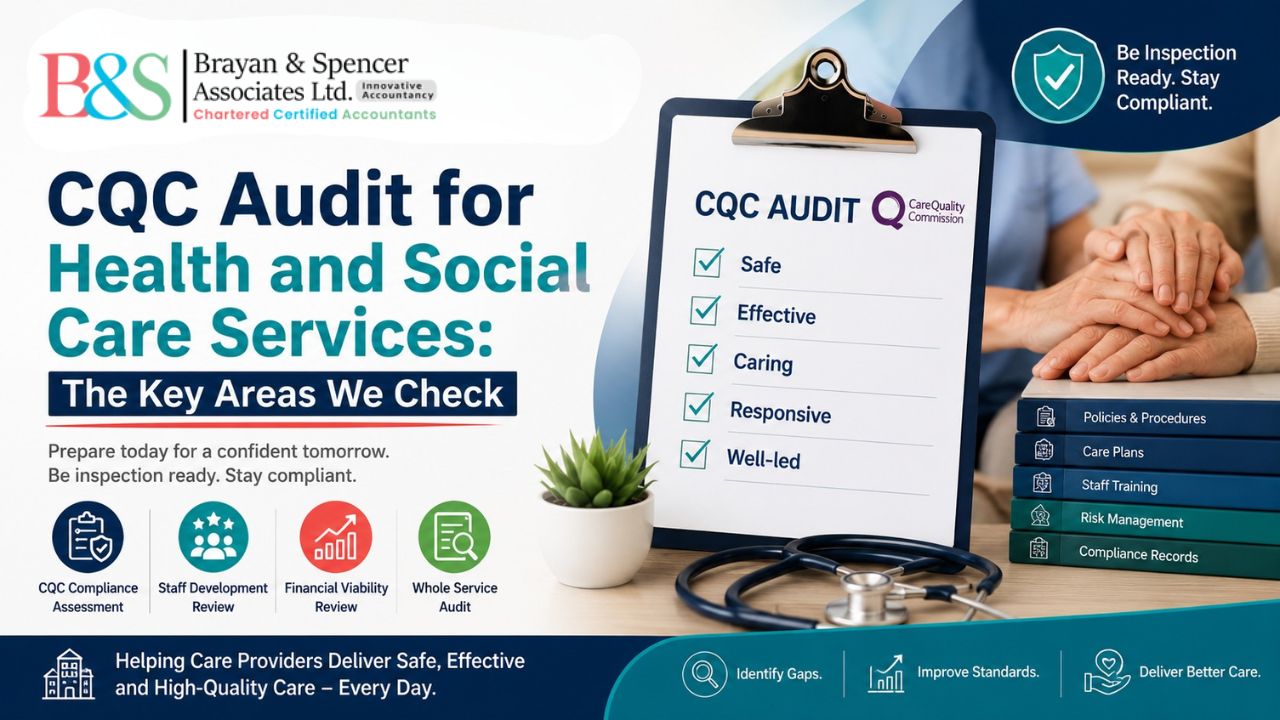
A good audit doesn’t stop checking whether documents exist. It looks at whether your service can demonstrate, in practice, that care is safe, effective, caring, responsive, and well-led, the same five key questions CQC itself asks. That means talking to staff, reviewing records for consistency rather than just presence, and, where relevant, assessing whether the service is financially sound enough to sustain the care it provides.
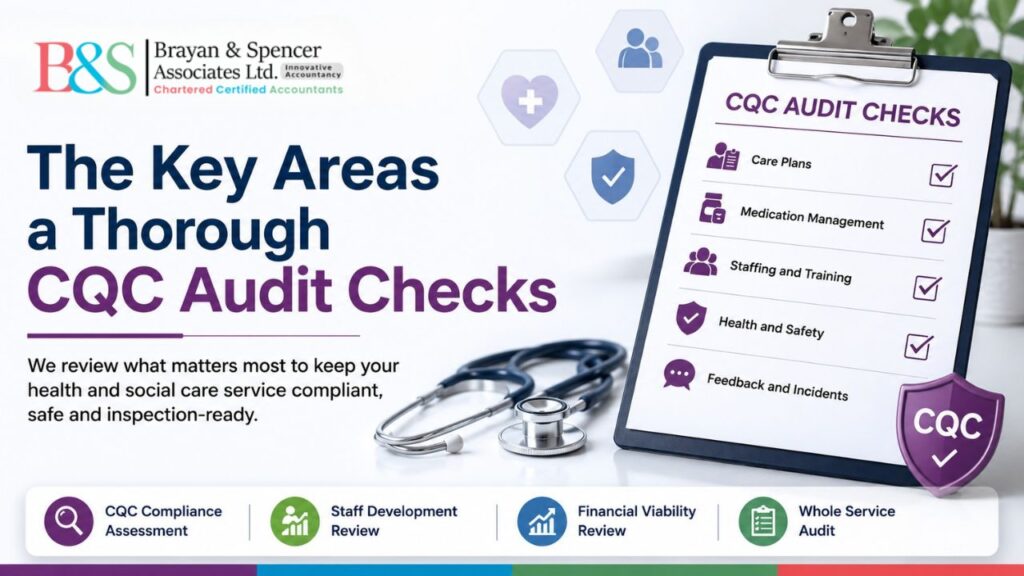
The Key Areas a Thorough CQC Audit Checks
Care Plans
A proper audit checks whether care plans are genuinely person-centred: built around what everyone actually needs, reviewed regularly, and updated promptly when circumstances change. It’s not enough for a plan to exist. It needs to match what’s actually happening day to day, since a mismatch between the plan and the daily notes is one of the fastest ways a service loses ground during a real inspection.
Medication Management
This covers how medication is stored, administered, and recorded. We check whether Medication Administration Records (MAR charts) are completed at the time of administration, whether stock is reconciled regularly, and whether errors are properly reported and followed up rather than quietly corrected and forgotten.
Staffing and Training
We review recruitment checks, including Enhanced DBS screening, alongside training records, supervision logs, and competency assessments. The goal isn’t just confirming training happened. It’s checking whether staff can explain and apply what they’ve learned, since that’s exactly the difference an inspector notices in a real conversation.
Health and Safety
This includes the physical environment, equipment maintenance and servicing records, infection control practices, fire safety documentation, and risk assessments covering everything from moving and handling to water safety. Gaps here tend to be procedural rather than deliberate; records that lapse once daily care pressures take priority. That’s exactly why a scheduled audit catches them before an inspector does.
Feedback and Incidents
We review how complaints are handled from first report through to resolution, how incidents and accidents are logged, and, critically, whether there’s clear evidence that lessons actually changed practice. A log that records what happened but never what was learned is a governance gap CQC audits are specifically designed to catch.
How We Structure a Complete Audit
Beyond checking these individual areas, our CQC audits are built around four things:
- CQC compliance assessment. We measure your service directly against the five key questions CQC uses, Safe, Effective, Caring, Responsive, and Well-led, identifying specific, actionable areas for improvement rather than a generic pass or fail.
- Staff development review. A gap analysis of training needs and performance, giving you clear guidance on appraisals and individual learning plans rather than a single blanket training recommendation.
- Financial viability review. As qualified accountants, we assess whether your service is financially sustainable enough to maintain safe staffing and consistent care, a dimension most care-focused audits leave out entirely.
- Whole service audit. A full review across every regulated activity your service delivers, benchmarked against current CQC standards rather than the standards that applied when you were last inspected.
Every audit is tailored to the specific service in front of us. A domiciliary care agency, a residential care home, and a GP practice are all measured against the same five key questions, but the evidence that actually matters looks different in each setting. A generic checklist applied uniformly across all three tends to miss exactly the detail that matters most.
If you’d rather work through the documentation side yourself first, our full document-by-document CQC audit checklist is a practical place to start. And for a closer look at what genuinely separates a strong audit from a surface-level one, see what separates a genuine audit from a box-ticking exercise.
More Than Compliance: Specialist Healthcare Accounting Alongside Your Audit
CQC compliance and sound financial management aren’t separate problems for a health or social care service; they’re closely linked, which is exactly why our accountancy background shapes how we approach every audit.
Brayan & Spencer Associates is a tax advisory and accountancy firm and Healthcare Accounting in London is one of our core specialisms. We work regularly with doctors, GPs, pharmacists, nurses, clinical practitioners, and care providers of every size across the UK, which means the financial viability review built into our audits isn’t a generic add-on. It’s informed by the same expertise we bring as accountants for medical professionals day to day.
For many services, this connection matters more than it first appears. A care provider that’s compliant on paper but stretched financially is still a service at genuine risk, and a firm that only understands care practice, without also understanding healthcare accounting, can’t fully assess that risk. Bringing both under one roof is what makes our audits genuinely complete rather than partial.
Why This Matters Beyond Passing an Inspection
An audit isn’t only useful for inspection preparation. Done properly; it gives your team confidence, gives your Registered Manager a clear, evidenced picture of where the service stands, and gives leadership an early warning on the specific areas most likely to affect a future rating.
Services that treat an audit as a one-off event tied only to a known inspection date tend to be the ones caught out later. CQC increasingly assesses services continuously, using data gathered between visits rather than only at scheduled inspections, so a quiet period doesn’t necessarily mean a low-risk one.
Brayan & Spencer Associates: A Helping Hand Through Your CQC Audit
This is where we come in. Brayan & Spencer Associates works alongside health and social care providers as a genuine helping hand through the audit process, not a firm that turns up, hands over a checklist, and leaves.
Our CQC compliance audit services cover every area outlined above, care plans, medication management, staffing and training, health and safety, and feedback and incidents, tailored specifically to your service rather than applied as a generic template. Because we’re a specialist tax advisory and accountancy firm as well as compliance experts, we also bring a financial viability review most care-focused auditors simply can’t offer, drawing on our wider work in healthcare accounting in London and beyond.
We provide ongoing CQC compliance support for services that want to stay consistently audit-ready throughout the year and focus on CQC inspection support once a visit is confirmed and time is tight. For providers still working toward registration, our CQC registration support covers the same ground right from the start, so the relationship doesn’t begin and end with a single audit.
Whatever stage your service is at, our aim is the same: make sure your team feels confident, your documentation holds up under scrutiny, and your care reaches the standard CQC expects.
Speak to our team about a CQC audit tailored to your service. Visit Brayan & Spencer Associates or call 0207 183 5956.
Frequently Asked Questions
A CQC audit is an independent evaluation of a health or social care service’s procedures, records, and practice, assessed against the standards CQC itself uses to inspect and rate providers. It’s designed to identify gaps in advance, rather than waiting to discover them during a live inspection.
Most audits assess care plans, medication management, staffing and training, health and safety, and how feedback and incidents are handled. A thorough audit also benchmarks the service directly against CQC’s five key questions and, increasingly, financial viability.
A CQC audit is an independent, provider-commissioned review, usually conducted ahead of an inspection to identify and close gaps. A CQC inspection is carried out by the regulator itself and directly determines the service’s official rating.
A complete audit increasingly should, since a service that’s compliant on care practice but financially unsustainable is still at risk. This is a common gap in audits carried out by care-practice specialists without financial expertise, which is exactly where Brayan & Spencer Associates’ accountancy background adds real value.
Most services benefit from an audit at least annually, with more frequent reviews recommended after a requirement of notice, a significant change in staffing or leadership, or ahead of a confirmed or expected inspection.
Yes, and it should be. While every regulated service is measured against the same five key questions, the specific evidence that matters differs between a domiciliary care agency, a residential care home, and a clinical setting like a GP practice.