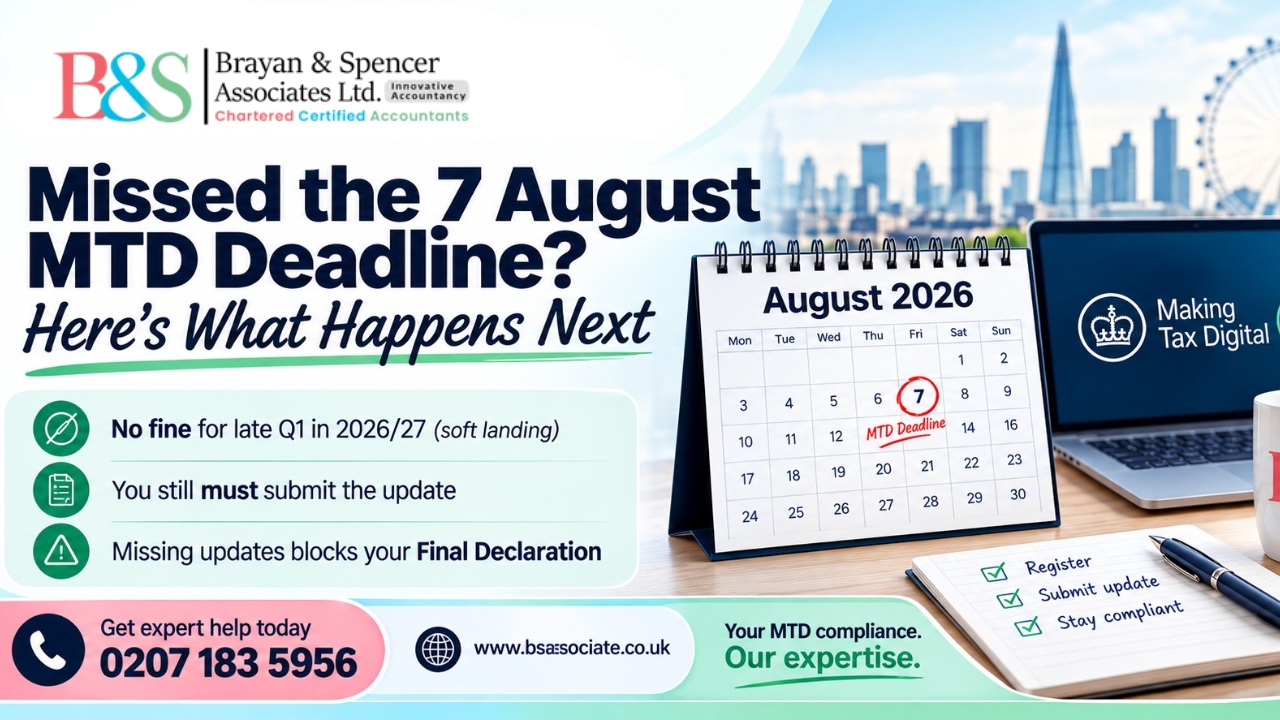
Quick answer: There’s no fine for missing 7 August 2026. HMRC built a first-year soft landing into Making Tax Digital. It removes penalty points and fines for late quarterly updates in 2026/27. But you still need to submit it, and all four quarterly updates must go in before you can file your Self Assessment Final Declaration.
If your first MTD quarterly update is still sitting unsubmitted, take a breath. You’re not alone. HMRC confirmed that hundreds of thousands of sole traders and landlords were still not fully signed up in the final weeks before the deadline. A lot of people across London are reading this exact page right now.
What you do in the next few days matters more than what you missed on the day itself. Below is a straight answer to “what happens now,” followed by one detail most guides skip: a missed update doesn’t just sit there quietly. It blocks something bigger down the line.
No fine, but no free pass either
HMRC won’t fine you automatically for missing the 7 August 2026 MTD deadline. The soft landing protects quarterly updates specifically. It exists because this was the first cycle of a brand-new system, with new software and new habits to learn.
But “no penalty” isn’t the same as “no obligation.” The requirement to submit your update hasn’t disappeared. Treating it as optional now is where people run into trouble later in the year. We covered who this deadline applies to, and why so many businesses got caught out, in our post on half of small businesses falling behind on MTD. Worth a read if you’re still unsure whether the £50,000 threshold applies to you.
Why HMRC isn’t fining you, for now
Making Tax Digital for Income Tax became a legal requirement on 6 April 2026. It applies to sole traders and landlords with qualifying income over £50,000. The first quarterly update covered 6 April to 5 July, and it was due by 7 August 2026.
HMRC knew this was the first cycle of a new system. So it confirmed a simple rule: no penalty points for late quarterly updates during 2026/27. This soft landing covers the quarterly update only. It doesn’t cover late payment penalties or late filing of your Self Assessment return. Both of those still follow the existing rules.
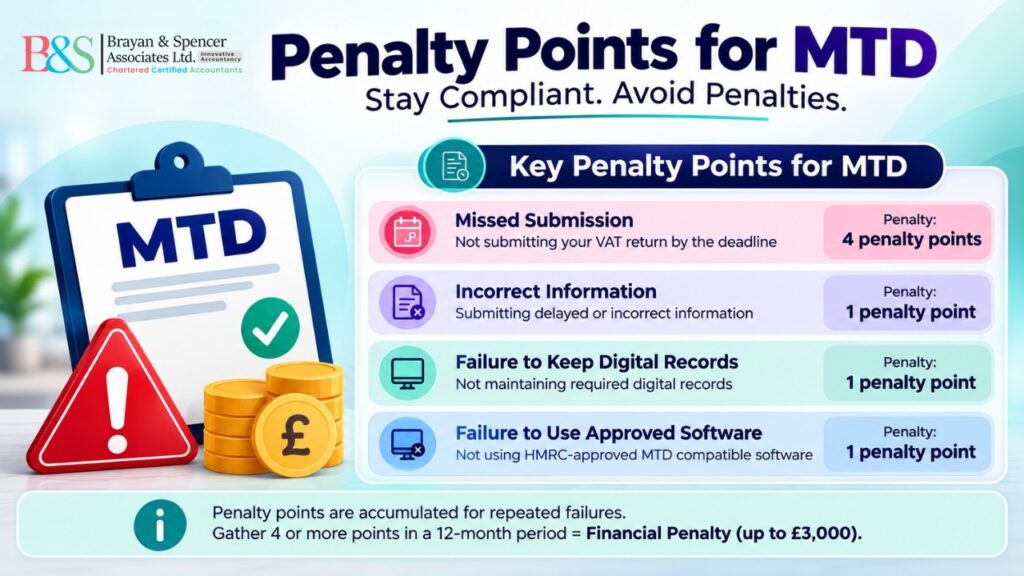
The concession ends when the 2027/28 tax year begins. From that point, every missed quarterly deadline earns one penalty point. Once you reach four points, HMRC charges a fixed £200 penalty. Each further late submission adds another £200 while you stay at that threshold. Points do expire after a run of on-time filing, but the clock only starts once you’re actually filing on time.
The catch almost nobody mentions
This is the part that turns “late but fine” into a real problem if you leave it too long. You cannot file your Final Declaration (the new name for your annual Self Assessment return) until you’ve submitted all four quarterly updates for the year. The Final Declaration is due 31 January 2028 for the 2026/27 tax year. It pulls together your cumulative quarterly figures, your End of Period Statement, and any other income you have. The system needs all four updates in place first.
Why skipping one update creates a bigger problem later
Skipping Q1 doesn’t erase it. The obligation carries forward and stacks up alongside Q2, Q3 and Q4. Leave it too long, and January doesn’t bring one overdue update. It brings four, submitted in a rush, feeding straight into a Final Declaration that carries its own penalty regime. That regime charges £100 immediately for late filing, then daily penalties after three months. Late doesn’t mean skippable. It means the debt to HMRC’s system keeps growing until you clear it.
What to do this week
- Submit the missed update now, through your MTD-compatible software. There’s no separate “late submission” process. You file it exactly as you would have on time, just after the date. HMRC’s system accepts it and moves on. You don’t need to explain or appeal anything under the soft landing.
- Check you’re actually registered and connected. Haven’t signed up for MTD yet? You still can, via GOV.UK. Your software also needs authorisation to talk to HMRC through Government Gateway before you can submit anything.
- Bring your digital records for 6 April to 5 July fully up to date. A quarterly update reports category totals: income and expenses by type, built from records you keep as you go. A shoebox of receipts sorted after the fact is where mistakes creep in.
- Put 7 November in your diary today. That’s your Q2 deadline. The soft landing won’t protect a pattern of late filing once the 2027/28 penalty rules land. Building the habit now is cheap insurance.
- Get a second pair of eyes on the numbers before you submit, especially if this is your first time using the software. A quick review now costs far less than fixing errors at your Final Declaration in January. For a full walkthrough of what each quarter needs, read our guide on MTD for Income Tax and the quarterly deadline.
What this means if you’re a landlord or sole trader in London
London has a lot of buy-to-let landlords, freelancers, and small business owners. Income over £50,000 is common here, sometimes from a single rental property plus consultancy work, sometimes from two smaller self-employed income streams that add up. If you’ve only just realised the MTD quarterly update deadline applied to you, this soft landing exists for exactly that reason.
Our guide to Making Tax Digital for Income Tax from April 2026 explains who’s in scope and how the phased thresholds run through to 2028. Our dual guide for landlords and sole traders is worth bookmarking if you manage both types of income. And if MTD is still new to you, start with 6 things you should know about MTD for Income Tax.
Brayan & Spencer Associates works with sole traders, landlords, and small businesses across London on exactly this situation. We check whether you’re correctly registered, connect your software, file the missed update properly, and set up a system so Q2 doesn’t turn into the same scramble. Missing one deadline is recoverable. A pattern of missed deadlines, once penalty points start in April 2027, actually costs money.
Don’t let a missed update turn into a missed year. Call Brayan & Spencer Associates on 0207 183 5956 or visit www.bsassociate.co.uk to get your quarterly update filed and your MTD compliance sorted before 7 November.
For more on the common slip-ups we see at this stage, read 7 common mistakes sole traders make when preparing for MTD, or browse all our latest guidance in the Making Tax Digital blog category.
FAQs: Missing the 7 August MTD Deadline
No. HMRC’s soft landing means no penalty points or fixed fines apply to late quarterly updates during the 2026/27 tax year, which is the first year of MTD for Income Tax. You should still submit it as soon as possible.
No. The soft landing only removes penalty points for late quarterly updates. Late payment penalties and late filing penalties for your annual self – assessment return, now called the Final Declaration, continue to apply under the existing rules.
No. All four quarterly updates for the tax year must be submitted before you can file your Final Declaration. Skipping one doesn’t remove the obligation; it just means the update is still outstanding when your later deadlines arrive, increasing the chance of errors and delays at year-end.
From the 2027/28 tax year, each missed quarterly deadline earns one penalty point. Once you accumulate four points, HMRC issues a fixed £200 penalty, with a further £200 charged for each additional late submission while you remain at that threshold. Points expire after a sustained period of on-time filing.
No. You can still sign up for Making Tax Digital for Income Tax now via GOV.UK or through an agent. You’ll need HMRC-recognised software connected via Government Gateway before you can submit any outstanding updates.
Your second quarterly update, covering 6 July to 5 October (or the equivalent calendar quarter if you’ve chosen that option), is due by 7 November 2026. It’s worth submitting your late Q1 update well before then to avoid entering Q2 with two outstanding updates.
Yes. An accountant with agent access to your MTD account can file overdue quarterly updates on your behalf, check your digital records are accurate, and make sure your software is correctly connected so future deadlines aren’t missed. Brayan & Spencer Associates handles this daily for sole traders and landlords across London, call 0207 183 5956 to get started.