
Penalty points. A £200 fixed charge. A soft landing for 2026/27. If you have read up on Making Tax Digital penalties, you already know the rules on paper. What most guides skip is the part that matters to your bank balance: what a missed deadline costs in real pounds, once filing penalties, payment penalties, and daily interest are added together.
This MTD penalty example walks through realistic, HMRC-sourced figures, so you can see exactly where the cost comes from, and more usefully, exactly where it can be avoided.
Quick Answer: How Much Can a Missed MTD Deadline Cost?
For most sole traders and landlords, a late quarterly update in 2026/27 costs nothing directly, thanks to the first-year soft landing. Late payment of tax owed is a separate, unprotected charge, combining a 3% penalty at 15 days overdue, a further 3% at 30 days, 10% per year after that, and daily interest currently running at 7.75%. On an £8,000 tax bill paid 45 days late, that adds up to roughly £590 in penalties and interest alone, on top of the tax itself.
The two systems run independently. That is the single most misunderstood part of MTD late payment penalties, and exactly why a worked example is more useful than a rules list. If you are still confirming whether MTD applies to you at all, our Self Assessment Tax Return service can check your position first.
Two Penalty Systems, Two Separate Clocks
Under Making Tax Digital for Income Tax, HMRC operates two distinct penalty regimes that run in parallel, not together.
- Late submission penalties apply to a missed quarterly update or Final Declaration. This is the points-based system: each late submission earns a point, and once you cross the threshold (four points for quarterly filers), HMRC issues a fixed £200 penalty.
- Late payment penalties apply to taxes that are not paid on time. This is percentage-based, tied directly to how much you owe and how many days it stays unpaid, and it compounds the longer the delay runs.
The critical detail: the 2026/27 soft landing protects you from system one only. It does nothing for system two. You can avoid every quarterly update point this year and still face a real financial penalty if a tax payment runs late. For a full breakdown of the points system itself, see our companion guide, MTD Penalties 2026/27: 5 Key Rules to Know.
Worked Example: Year 1 vs Year 2 for a landlord
Consider a landlord with rental income of £62,000, mandated into MTD from 6 April 2026. Our Property & Real Estate accounting service works with clients in exactly this position.
Year 1: 2026/27, the soft-landing year
Her Q1 quarterly update, due 7 August 2026, goes in two weeks late while she gets new software set up. Because 2026/27 is a protected year for quarterly updates, no penalty point is issued. She still must file it before her Final Declaration can be submitted, so the delay costs her admin time this year, not money.
Year 2: 2027/28, points start counting
The soft landing has ended. Her Q1 update slips again, this time by three weeks during an accountant handover, and this time it earns a penalty point. Three further late updates over the following months pushed her to four points, and HMRC issued the £200 fixed penalty. Points do not clear immediately either. They typically reset only after a run of consistent on-time filing, so a pattern of near misses can sit on record for longer than most people expect.
Worked Example: What Late Payment Actually Costs
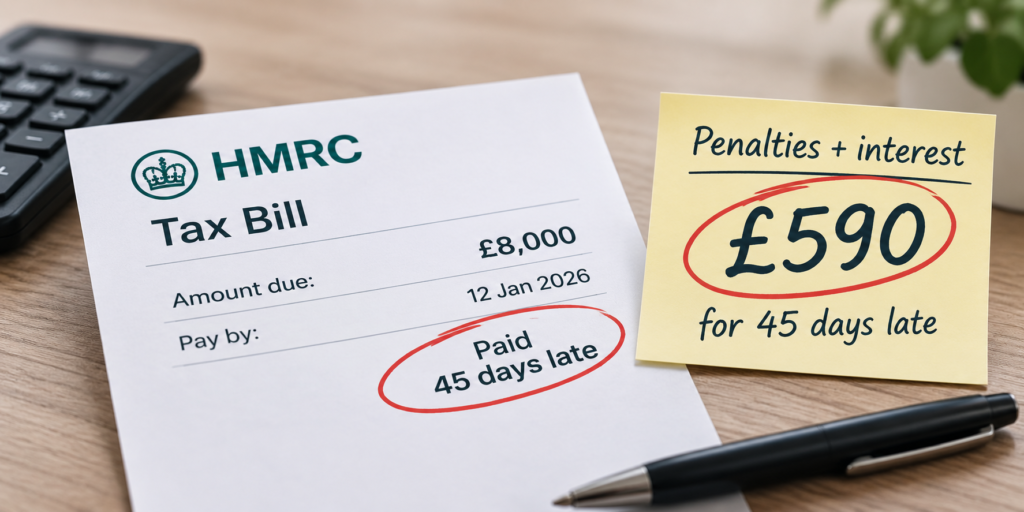
Now take the same landlord’s tax bill, separately from her filing record. She owes £8,000 and pays it 45 days after the due date.
Under the late payment penalty structure that applies to MTD taxpayers:
- 3% of £8,000 charged once the payment is 15 days overdue equals £240
- A further 3% of £8,000 charged at 30 days overdue equals £240
- 10% per year, accruing daily from day 31 onward, adds roughly £33 for the remaining 15 days to reach day 45
That is approximately £513 in penalties alone. On top of that, HMRC charges late payment interest separately, currently 7.75% per year, running from the original due date until the balance is cleared. Over the same 45 days, that adds a further £76 or so.
Total: roughly £590 in penalties and interest on a six and a half week delay, before factoring in any professional fees to resolve the position, and before considering that the 10% annual charge keeps compounding daily the longer the balance sits unpaid.
(Figures are illustrative, based on rates published by HMRC and confirmed as current in early 2026. Interest rates move with Bank of England base rate changes, and your own exposure depends on your exact tax owed and days overdue. Our Taxation service can model your specific figures on request.)
The One Action That Limits Your Exposure Every Time
Across both scenarios, one thing consistently changes the outcome: contacting HMRC before a payment is due if you know you cannot pay in full. Agreeing a Time to Pay arrangement before the penalty clock starts generally stops the percentage-based late payment penalties applying, although interest continues to accrue on the outstanding balance until it is cleared. Filing on time even when payment is delayed also matters, because the two penalty systems are assessed independently, so getting one right still halves your exposure to the other. This applies to payroll obligations too, which is why our Payroll Services team builds payment deadlines into client reporting as standard.
Why This Matters More Than It Did Under the Old System
Before MTD, most sole traders and landlords dealt with a single annual deadline and a comparatively forgiving penalty structure. Under MTD, tax positions are visible to HMRC in near real time, four times a year, and the payment penalty regime tied to MTD is materially stricter than the older system it replaces these taxpayers. That combination of more frequent reporting and a tougher payment penalty structure is exactly why treating quarterly updates and tax payments as two separate, equally important deadlines matters more now than it used to. This applies just as much to contractors managing CIS deductions, where our CIS Services team can help keep both filing and payment on track.
How We Can Help
Our team manages MTD submissions, tracks payment deadlines before they are missed, and sets up Time to Pay arrangements where cash flow is tight, so neither clock runs against you. Related services:
Do Not Let Two Separate Clocks Catch You Out
Filing and payment penalties are far cheaper to prevent than to unwind after the fact. Book a free MTD review with our ACCA and FCA qualified team, and we will check your submission history, your payment status, and flag anything at risk before HMRC does.
Book Your Free MTD Review Now →
Or call 0207 183 5956 to speak to our team today.
Sources: GOV.UK, Penalties for late submission; GOV.UK, Making Tax Digital for Income Tax guidance; HM Treasury and HMRC policy paper on increased late payment penalty rates for VAT and Income Tax Self Assessment taxpayers joining Making Tax Digital.
FAQ: MTD Penalty Costs
No. It only protects you from late submission penalty points on quarterly updates. Late payment penalties and interest on unpaid tax apply regardless of the soft landing.
It is charged in stages: 3% of the outstanding tax once it is 15 days overdue, a further 3% once it is 30 days overdue, then 10% per year accruing daily from day 31 until the balance is paid, in addition to separate daily interest.
As of early 2026, HMRC’s late payment interest rate is 7.75% per year, set at the Bank of England base rate plus 4%. This rate moves when the base rate changes, so check current figures before relying on it for planning.
Often, yes. Setting up a Time to Pay arrangement with HMRC before the payment penalty clock starts typically stops the percentage-based penalties from being charged, although interest continues to run on the outstanding balance.
Yes, but not immediately. Points are generally removed after a sustained period of on-time filing, meaning a string of near misses can leave points on your record longer than a single late update might suggest.
They are assessed independently, so both cost you. Filing on time while paying late still avoids submission points; paying on time while filing late still avoids payment penalties. Getting either one right limits your total exposure.