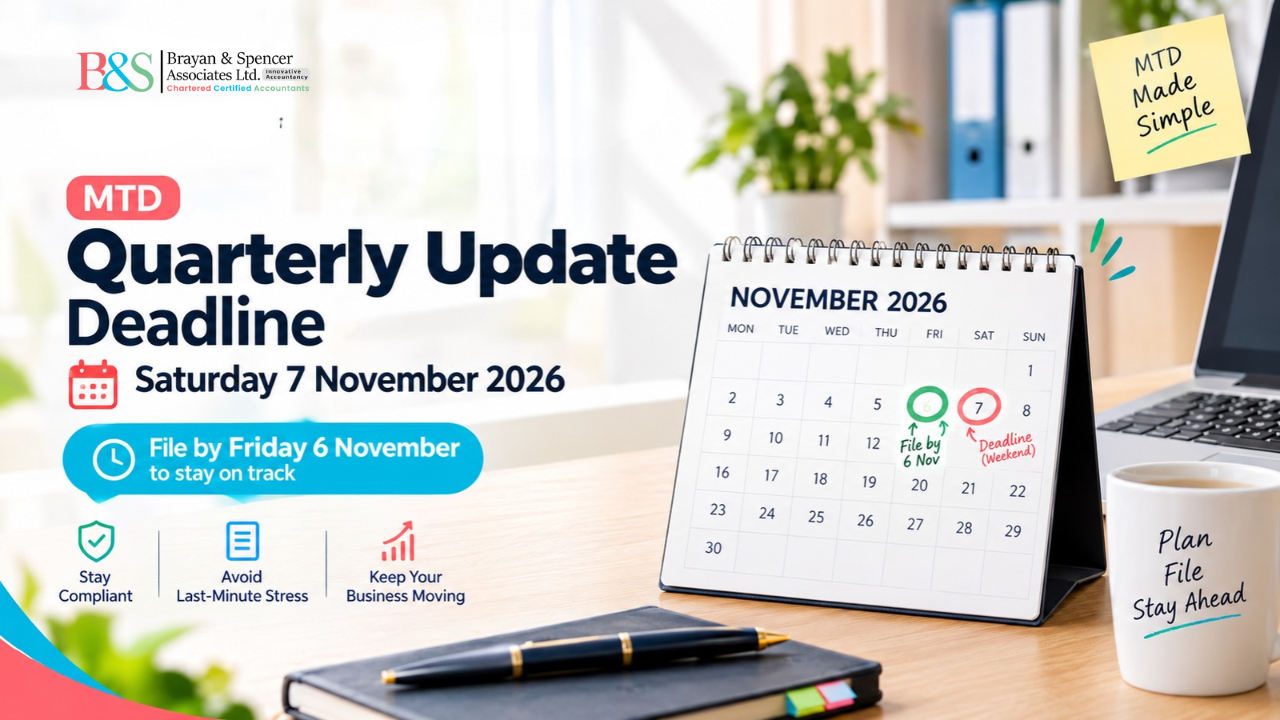
The MTD second quarter deadline is Saturday 7 November 2026. HMRC lets you send your second quarterly update any time after the update period ends, so if you use standard periods you can file now for 6 April to 5 October. Because the deadline falls on a weekend, plan to submit by Friday 6 November. No penalty points apply to late updates in 2026/27, but the update is still a legal obligation.
Why a Saturday deadline changes how you should plan
7 November 2026 is a Saturday, and that matters more than it sounds. HMRC’s guidance says you can send a quarterly update any time after the update period ends, up to and including the day of the deadline. It does not mention a weekend extension, so the sensible working assumption is that Saturday 7 November is the last day and Friday 6 November is your real one.
There is a practical reason to take Friday seriously. If your software throws up a connection problem, an authorisation error or a figure that looks wrong, you want a working day to fix it. The help available on the Saturday is narrower than on a weekday, as we explain below.
Which dates your update covers
Each quarterly update covers the tax year so far rather than just the latest three months, and your software works out the totals for you to check before you send. The end date depends on which type of update period you are using, and the deadline is the same for both.
| Update period type | Second update covers | Deadline |
| Standard (tax year) | 6 April to 5 October 2026 | Saturday 7 November 2026 |
| Calendar | 1 April to 30 September 2026 | Saturday 7 November 2026 |
If you have never checked which one you are on, look at what your first update used. HMRC says you cannot switch once an update has been sent in the tax year, so this is a check, not a decision. Standard periods are the default and suit anyone whose accounting period matches the tax year, while calendar periods are for accounting years running from 1 April to 31 March.
What HMRC expects inside the update
Think of the update as a set of totals rather than a tax calculation. Your software adds up your digital records for each income and expense category, and HMRC receives those category totals. It does not receive individual receipts or invoices. You also do not need to make accounting or tax adjustments first.
Two details catch people out. First, a quiet quarter still needs an update: if you received no income and had no expenses, you must still send it so HMRC knows. Second, the update is per business. If you run a trade and also let out a property, each source needs its own update. A sole trader who also lets a flat is filing twice, even though it feels like one task.
If you spot a mistake in what you sent in August, you do not reopen that update. HMRC says corrections go into your records and then flow into your next update, and ICAEW notes that each quarterly update overwrites the previous one. So the second update is your tidy-up opportunity as well as your next report.
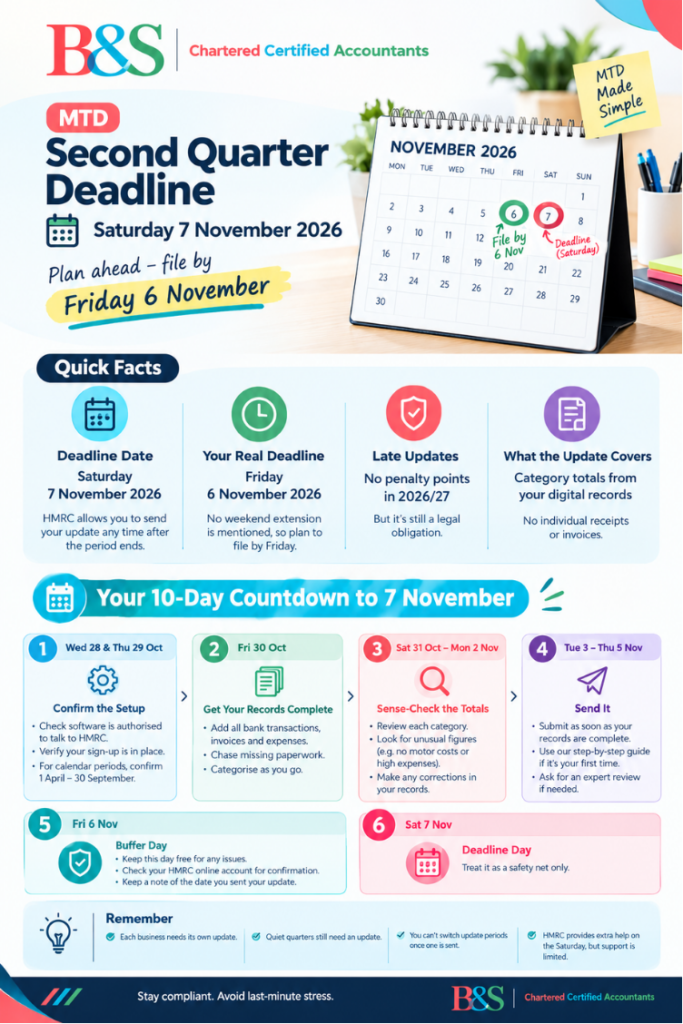
Your ten-day countdown to 7 November
As of Wednesday 28 October, ten days remain, counting deadline day. Here is a schedule that keeps your Saturday free.
Wednesday 28 and Thursday 29 October: confirm the setup. Check that your MTD software is still authorised to talk to HMRC and that your sign-up is in place. HMRC cannot advise on specific software products, so this is a job for your software provider’s help pages. If you use calendar periods, confirm that your software shows 1 April to 30 September rather than the standard dates. If your first update is still outstanding, our guide to what happens after missing 7 August explains where you stand.
Friday 30 October: get the records complete. Bring every bank transaction, sales invoice and expense up to the end of your update period into your software, and chase anyone holding paperwork you need. Categorise as you go, because the update is built from categories.
Saturday 31 October to Monday 2 November: sense-check the totals. Open the draft update and look at each category as a whole. A tradesperson with no motor costs, or expenses bigger than turnover, deserves a second look before sending rather than after. If your first update had a mistake, make the correction in your records now so it carries into this one.
Tuesday 3 to Thursday 5 November: send it. Nothing stops you submitting as soon as your records are complete, since the update period has already ended. If you have never pressed the button, our step-by-step submission guide walks through it. If you want an expert pair of eyes, this is the window to ask for one.
Friday 6 November: buffer day. Keep this free for anything that goes wrong. Check your HMRC online account afterwards for the confirmation that says you sent a quarterly update, and keep a note of the date.
Saturday 7 November: deadline day. Treat it as a safety net only.
What HMRC’s Saturday support covers, and what it does not
HMRC has said it will provide extra help on deadline day, even though its helpline is not normally open on Saturdays. On Saturday 7 November, the Self Assessment helpline will run from 9am to 3pm and webchat from 8am to 4pm. Phone support that day is for Making Tax Digital queries only. The Agent Dedicated Line will be closed, and the Welsh language helpline and extra support service will not be available.
HMRC’s own advice is to submit as early as you can and to get in touch during the week if you need help, when the full telephone service is running. If a query cannot be settled on the Saturday, a callback may be arranged, but it could come early the following week, which does not help if you were counting on that call to file by the deadline. That is the real argument for finishing by Friday.
Jointly let property: a choice that follows you to the fourth update
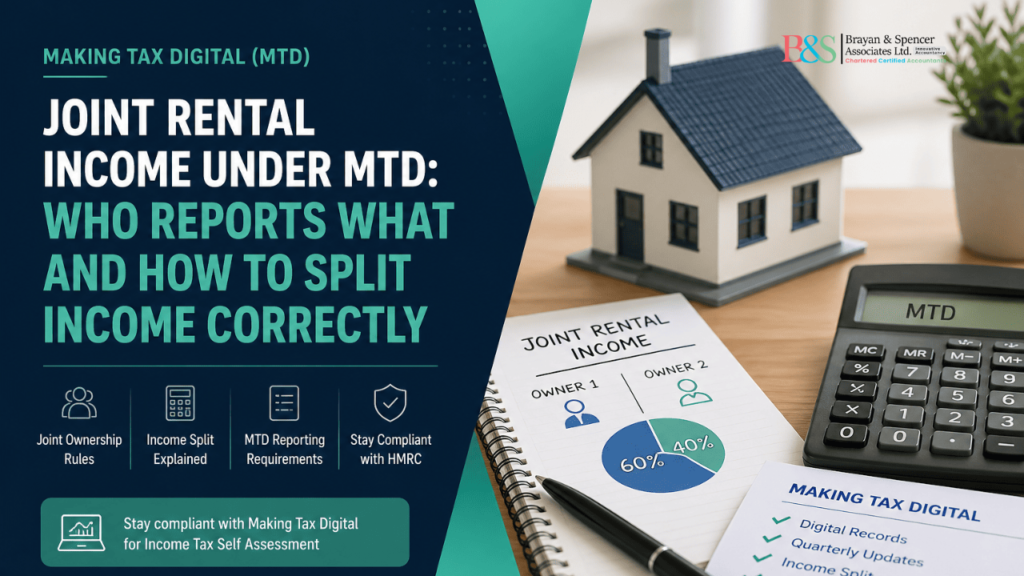
If you let a property jointly, HMRC gives you a choice in your quarterly updates. You can include both property income and expenses, or include income only. Choose income only and the jointly let property expenses must be reported after the tax year ends, by resending your fourth quarterly update before you submit your tax return. Any properties you own solely must still be reported with both income and expenses. Make the choice deliberately now, and keep a note of it, because it shapes the work waiting for you in spring. Our guide to joint rental income under MTD walks through the split.
After you press send: the tax estimate
Once the update is in, you can see an estimate of your tax bill for the year to date, in both your software and your HMRC online account. Treat it as a planning figure. HMRC says the estimate will be less accurate if you have other income sources it has not been told about, or if your accounting period does not match the tax year. Some software lets you add other income, such as savings interest, during the year, which gives a better estimate. Our breakdown of what the first MTD tax estimate does and does not tell you goes further.
A free pass this year is not a reason to coast
HMRC will not apply penalty points for late quarterly updates during 2026/27. That does not make the deadline optional. You need all of your quarterly updates in before you can submit your tax return through your software, and penalty points still apply to late tax returns. ICAS also points out that filing on time remains a legal obligation, and that there is currently no indication of the same easement for taxpayers entering MTD in 2027/28.
After 2026/27, a late quarterly update earns a late submission penalty point, and reaching four points brings a £200 penalty. Building the routine in a year without penalty points is cheap practice. Our worked example of what a late update really costs shows the numbers.
What comes after 7 November
The third update, covering the period to 5 January, is due on Sunday 7 February 2027. That is one week after the 31 January 2027 Self Assessment deadline for 2025/26, so January will be busy. The fourth update follows on 7 May 2027. If you will first fall into MTD for Income Tax in 2027/28, your trigger is combined gross income above £30,000 from self-employment and property in 2025/26, measured before expenses. Our 2027 readiness playbook covers that group.
How Brayan & Spencer Associates can help
We are a London accountancy and tax practice, and we help sole traders and landlords get their quarterly updates right first time, from checking category totals to confirming that corrections have carried through. If you want a second pair of eyes before Friday 6 November, our accountant and tax specialist team in London can review your figures, and our property tax accountants look after landlords with joint or multiple lets. Once your quarterly updates are done, our Self Assessment service handles the tax return. Call us on 0207 183 5956 or email info@bsassociate.co.uk.
Frequently asked questions
It is due by Saturday 7 November 2026. HMRC allows you to send it any time after your update period ends, up to and including deadline day, and the date is the same for standard and calendar update periods.
It covers your income and expenses for the tax year so far: 6 April to 5 October 2026 on standard periods, or 1 April to 30 September 2026 on calendar periods.
For Making Tax Digital queries only, yes. The Self Assessment helpline runs 9am to 3pm and webchat runs 8am to 4pm, but HMRC recommends asking for help earlier in the week.
No penalty points apply to late quarterly updates in 2026/27. You must still send every update before you submit your tax return, and late tax returns still attract penalty points.
Yes. If you had no income and no expenses in the period, you must still send the update to tell HMRC.