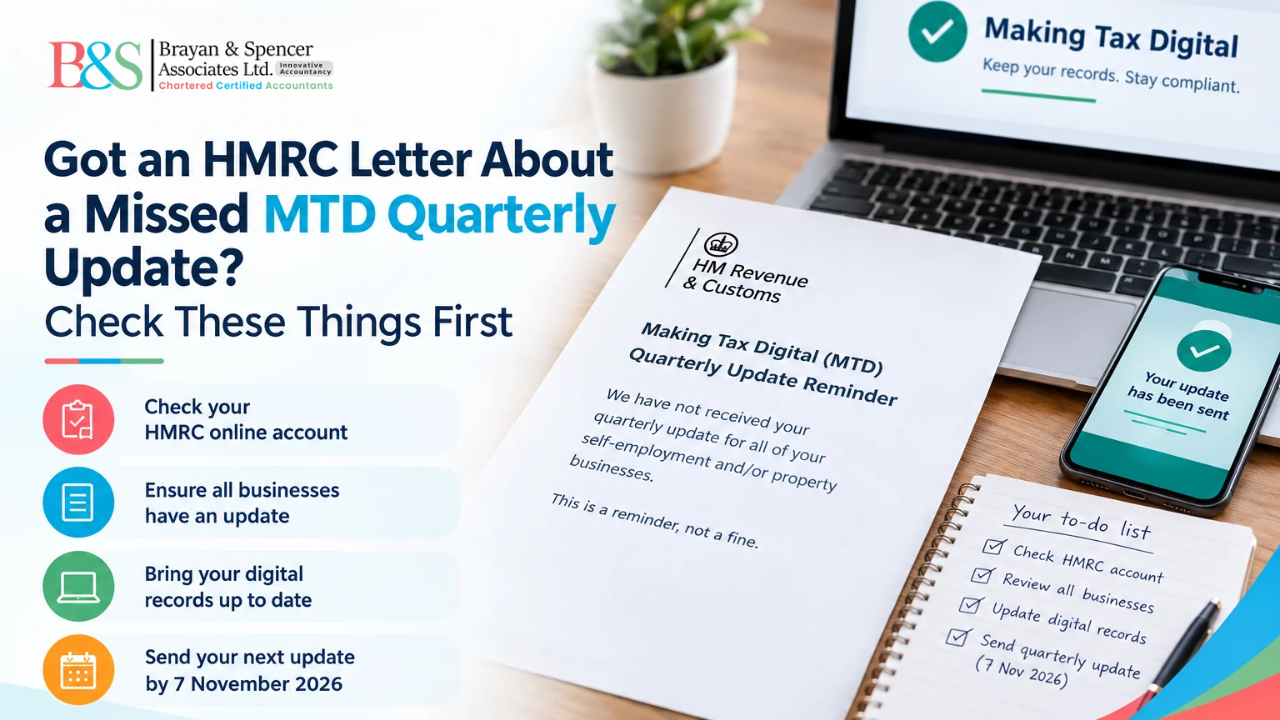
HMRC has started writing to sole traders and landlords who missed their first Making Tax Digital quarterly update. The letter is a reminder, not a fine. It can also reach people who did file something in August, because HMRC’s wording refers to all your self-employment and property businesses, not just one. If you have both kinds of income, one missing update is enough.
This guide is for people in the first MTD group: those whose 2024/25 tax return showed qualifying income above £50,000. HMRC defines qualifying income as your total turnover from self-employment and property before expenses. It explains why the letter may have arrived, what to check, and what to send before the next deadline on Saturday 7 November 2026.
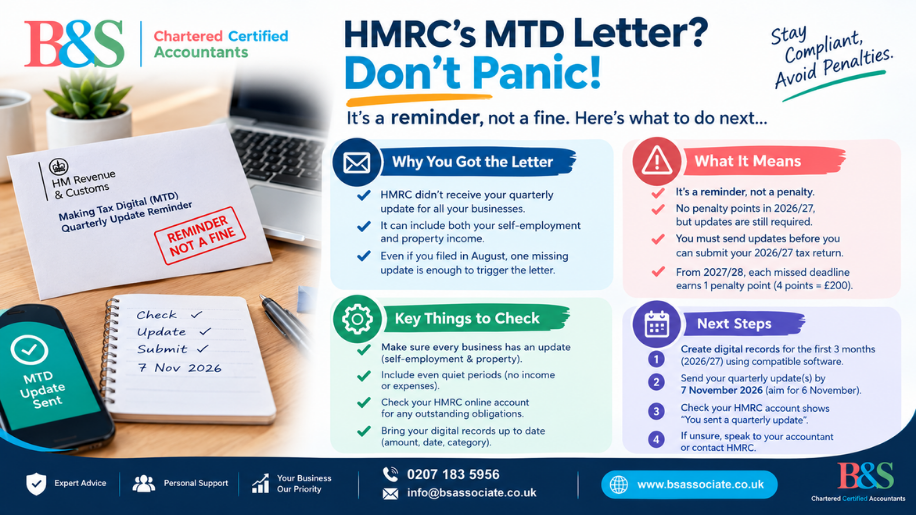
Quick answer: The letter is a reminder, not a penalty. For 2026/27, HMRC will not apply penalty points for late quarterly updates, but you are still legally required to send them, and they must be sent before you can submit your 2026/27 tax return. Check that every self-employment and property business has an update, bring your digital records up to date, and send the next update by 7 November. From 2027/28, each missed deadline earns one penalty point, and four points bring a £200 penalty.
Why HMRC may say you missed an update when you filed one
HMRC expects a separate quarterly update for each self-employment and property business you have. Its guidance and its reminder letter use the same example: someone who is self-employed and also has a property business must send an update for each. The letter says HMRC did not receive update information for all of your businesses by 7 August 2026, so a single gap can trigger it.
One update, two income sources
The most likely cause is sending an update for your trade but not your rental property, or the other way round. In your software it can feel like one job. In HMRC’s system it is two obligations, and the letter is triggered if either is outstanding.
A quiet period still needs an update
HMRC states that if you had no income and no expenses in an update period, you must still send the update so HMRC knows. If one of your businesses had a quiet spell and you skipped it, that business may still show as outstanding.
When something looks wrong
If you think HMRC’s record of your businesses is wrong, don’t guess. The letter says you can view your obligations through your HMRC online account. Check there first, then speak to your accountant or agent or contact HMRC before changing anything.
What the letter asks you to do, and what it does not
HMRC’s October 2026 reminder letter says that if you have not yet acted, you should create digital records for the first three months of the 2026/27 tax year using compatible software, and send your quarterly update as soon as possible. It then asks you to keep to the later deadlines of 7 November, 7 February and 7 May. If you use an accountant or agent, it says to speak to them first and give them a copy.
It does not charge you anything. HMRC’s penalties guidance says there are no penalties for missing a quarterly update deadline in 2026/27. You still need to keep digital records and send the updates before you can submit your tax return. Penalty points still apply to late tax returns.
Do you have to send the first update separately?
HMRC explains that each update covers the tax year so far, starting on 6 April, not only the latest three months. You can send an update at any time after its update period ends, up to and including the deadline.
The period for your second update has already ended. On standard periods it runs from 6 April to 5 October, and on calendar periods from 1 April to 30 September. So you can send it now rather than waiting for deadline day. Because updates are cumulative, the later figures include the earlier period.
HMRC’s published guidance doesn’t spell out whether a later update closes an earlier open obligation automatically. So after sending, check your obligations in your HMRC online account. If the first period still shows as outstanding, ask your agent or contact HMRC. If your first-period records are ready, sending the first update on its own is the most direct way to clear it.
An illustration: Sam, the consultant with a rental flat
This is a made-up example, not a real client.
Sam is a London consultant who also lets one flat. In August, Sam sent an update for the consultancy but not for the rental. In late October, a letter arrives.
Sam signs in to the HMRC online account and sees that the property business still has an open obligation. Sam brings the rental income and expenses up to date, then sends updates for both businesses covering 6 April to 5 October. Sam then checks that each obligation shows as met.
What to do this week
- Find the letter and show it to your accountant. HMRC asks agent-represented taxpayers to speak to their agent first.
- List your businesses. Write down each self-employment and property business you have, including any that are quiet.
- Check your obligations. Sign in to your HMRC online account and see which update HMRC says is outstanding.
- Bring your digital records up to date for each business. HMRC says each record needs the amount, the date and the category, using the same categories as Self Assessment.
- Send an update for every business. Aim for Friday 6 November, and treat Saturday 7 November as a safety net. Our step-by-step submission guide walks through the process.
- Confirm and keep a note. HMRC says your online account shows “You sent a quarterly update” afterwards. Note the date, and check that no obligation still shows as open.
What is paused in 2026/27 and what is not
| 2026/27 tax year | 2027/28 tax year | |
| Late quarterly update | No penalty points, but updates must be sent before the tax return | One point per missed deadline; at four points, a £200 penalty |
| Late tax return | Penalty points still apply | Penalty points apply |
| Late payment | Separate late payment penalties and interest apply | Separate late payment penalties and interest apply |
A year without penalty points is a cheap chance to build the routine. It is not a reason to put updates off. Four slips are worth avoiding:
- treating “no penalty” as “no obligation”;
- sending an update for one business and forgetting the other;
- skipping a quiet period;
- leaving everything to deadline day when 7 November is a Saturday.
For the full detail on that date, read our guide to the second quarterly update on Saturday 7 November. For the basics of a missed first update, see what happens after missing 7 August. Landlords with other income can also read our guide to rental income and self-employment under MTD.
When it is worth getting help
Help is most useful if you have more than one income source, jointly let property, keep records in spreadsheets, or can’t tell why the letter arrived.
Brayan & Spencer Associates is a London accountancy and tax practice working with sole traders and landlords. If you authorise us as your agent, we can review the letter with you, check which of your businesses HMRC shows as outstanding, and prepare your updates. Call us on 0207 183 5956 or email info@bsassociate.co.uk. You can also read about our accountant and tax specialist team in London.
Frequently asked questions
No. It is a reminder that HMRC did not receive update information for all of your businesses by 7 August. For 2026/27, HMRC is not applying penalty points for late quarterly updates. You still need to send them, because they must be in before you submit your tax return.
HMRC expects a separate update for each self-employment and property business. If you filed for one but not another, one obligation can still be open. A business with no income or expenses in the period also needs an update. Check each business in your HMRC online account.
Each update covers the tax year so far, so the later one includes the first period. HMRC’s guidance doesn’t say whether it closes the earlier obligation automatically. After sending, check your HMRC online account. If the first period is still outstanding, send it or ask your agent.
You will not receive a quarterly update penalty point in 2026/27, but you remain legally required to keep digital records and send updates. They must be sent before you can submit your 2026/27 tax return. From 2027/28, each missed deadline earns one penalty point.
Yes. HMRC’s letter says that if you have a tax accountant or agent, you should speak to them first and give them a copy. They can check your obligations and records before anything is sent.