
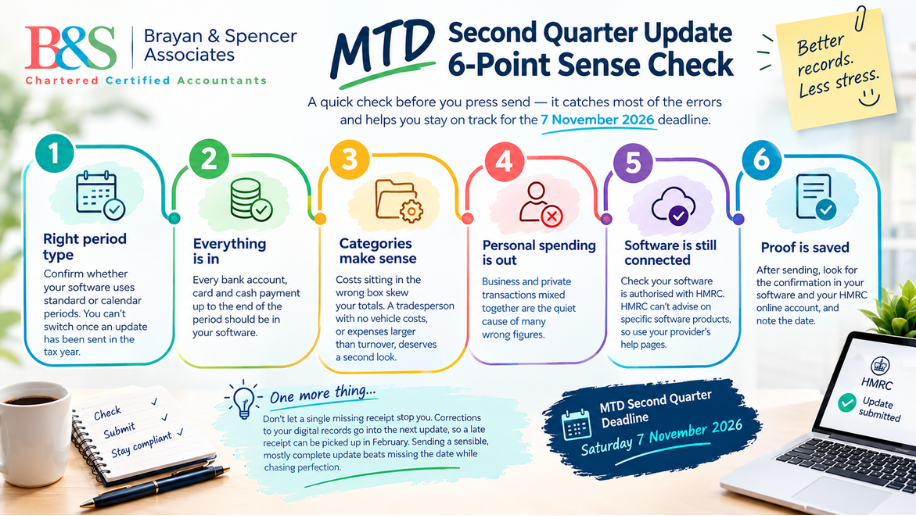
The MTD 2nd quarter deadline is Saturday 7 November 2026. Your update should cover 6 April to 5 October 2026, or 1 April to 30 September 2026 if you chose calendar periods. If you are a sole trader or landlord already in Making Tax Digital for Income Tax, you have a little over a week left. Rather than repeating the timeline, this guide helps you work out which type of filer you are, so you know exactly what to do next.
MTD second quarter deadline briefly
| Question | Answer |
| Deadline | Saturday 7 November 2026 |
| Standard periods cover | 6 April to 5 October 2026 |
| Calendar periods cover | 1 April to 30 September 2026 |
| Who must file | Sole traders and landlords mandated from April 2026 (qualifying income over £50,000) |
| Penalty points for lateness in 2026/27 | None |
| Next deadline | Sunday 7 February 2027 |
Why this deadline trips people up
Many people read “second quarter” and assume it means July to September. It doesn’t. Updates are cumulative, so your second update is a running total from the start of the tax year. Each quarterly update overwrites the previous one, which means it replaces your August figures rather than sitting on top of them.
Then there’s the calendar. A Saturday deadline means your real working deadline is Friday 6 November, because that’s the last day you can reliably fix a problem with a full service behind you. Think of Saturday as the safety net, not the plan.
Which type of filer are you?
Most people fall into one of five groups. Find yours and follow the steps.
1. You filed in August and everything went smoothly
You’re in good shape, but don’t send a copy of last quarter’s update. Add everything from 6 July onwards, and expect your first quarter’s figures to appear again inside the new running total. Look through the draft, correct anything that looks off, and send it early in the week. Nothing is gained by waiting for the weekend.
2. You missed the 7 August update
Don’t panic, and don’t send two updates. As reported from HMRC’s software guidance, the second update satisfies the obligations for both the first and second quarters. Bring your records right back to 6 April, check each category, and send one complete update before 7 November. If HMRC has already written to you, our guide to the HMRC letter about a missed MTD quarterly update explains what the letter means and how to respond.
3. You had a quiet quarter
No income and no expenses doesn’t mean no update. A nil update still has to go in so HMRC knows nothing was missed. Check your software is set to send it, because some people assume “nothing to report” means “nothing to do”.
4. You’re a landlord with joint or several properties
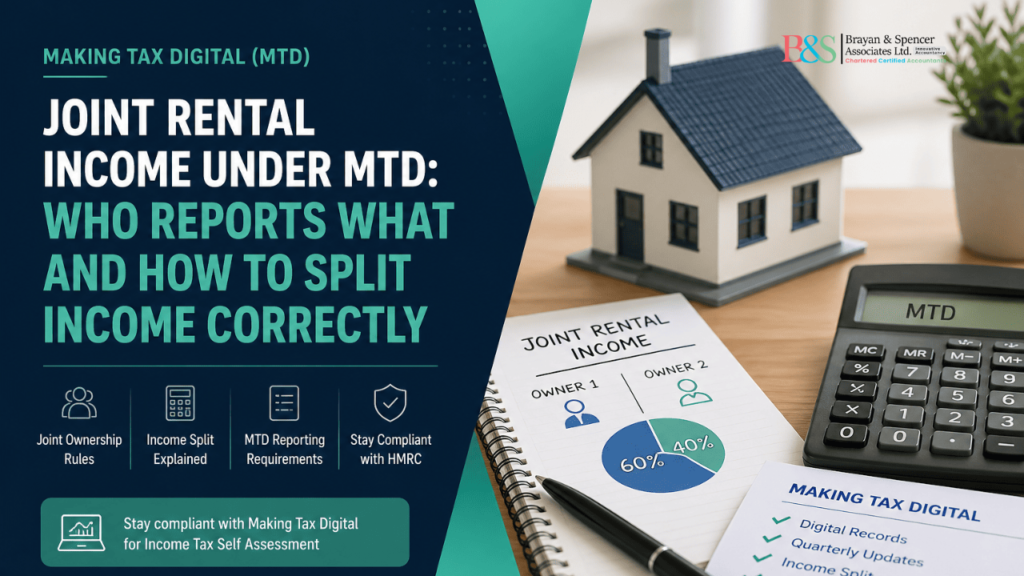
Each income source needs its own update, so a trade plus a rental property means two submissions, not one. With jointly let property, you can choose to report income and expenses, or income only. Choosing income only means the expenses must be reported after the tax year ends. Make that decision on purpose, and write it down, because it shapes your spring workload. Our guide to joint rental income under MTD shows how the split works.
5. Your accountant files for you
Good, but timing matters more than you’d think. Your accountant can only send what you give them, and they need time to query anything odd. Send your records early in the week, not on Thursday night. It also helps to know that HMRC’s Agent Dedicated Line won’t be open on Saturday 7 November, so agents have fewer options if something breaks on the day.
The six-minute sense check before you press send
Before you submit, run through this list. It’s quick, and it catches most of the errors that cause trouble later.
- Right period type. Confirm whether your software uses standard or calendar periods. You can’t switch once an update has been sent in the tax year.
- Everything is in. Every bank account, card and cash payment up to the end of the period should be in your software.
- Categories make sense. Costs sitting in the wrong box skew your totals. A tradesperson with no vehicle costs, or expenses larger than turnover, deserves a second look.
- Personal spending is out. Business and private transactions mixed together are the quiet cause of many wrong figures.
- Software is still connected. Check your software is authorised with HMRC. HMRC can’t advise on specific software products, so use your provider’s help pages.
- Proof is saved. After sending, look for the confirmation in your software and your HMRC online account, and note the date.
One more thing: don’t let a single missing receipt stop you. Corrections to your digital records go into the next update, so a late receipt can be picked up in February. Sending a sensible, mostly complete update beats missing the date while chasing perfection.
Saturday 7 November: what help is available
HMRC will run the Self Assessment helpline from 9am to 3pm on Saturday 7 November, with webchat from 8am to 4pm, for MTD for Income Tax queries. The Welsh language and vulnerable customer helplines won’t be running. If a query can’t be settled on the day, a callback may be arranged, but it could come early the following week.
That last point is the important one. A callback on Tuesday doesn’t help if your deadline was Saturday. If you suspect a problem, such as a login issue or an authorisation error, deal with it mid-week while the full service is running.
No penalty points isn’t the same as no consequences
For 2026/27, no penalty points will be issued for late quarterly updates. That’s a welcome easement, but it’s temporary. From the 2027/28 tax year, penalty points apply to all late submissions, with one point per missed deadline and a £200 penalty once you reach four points.
There’s a practical reason not to coast, too. You still have to send your quarterly updates before you can submit your tax return through your software, and late tax returns still earn penalty points. Treat this year as a rehearsal. If you want to see the numbers, our worked example of what a late MTD update really costs shows how quickly points add up.
What happens after 7 November
Your next milestones fall close together, so plan ahead:
- 31 January 2027: Self Assessment return for 2025/26, filed the usual way.
- 7 February 2027 (Sunday): third quarterly update, covering 6 April to 5 January.
- 7 May 2027: fourth quarterly update, covering the full tax year.
If you aren’t in MTD yet, your turn is coming. Sole traders and landlords with qualifying income of £30,000 and over must comply from 6 April 2027, and those at £20,000 and over from 6 April 2028. Our 2027 readiness playbook and our guide on how to sign up for MTD for Income Tax will get you started. HMRC has also been moving some taxpayers into the system automatically, which we cover in our post on HMRC auto-enrolment into MTD.
How Brayan & Spencer Associates can help
We’re a London accountancy and tax practice helping sole traders and landlords get their quarterly updates right the first time. We can check your category totals, confirm that corrections from earlier quarters have carried through, and make sure nothing is left to chance before the deadline.
If you’d like a second pair of eyes before Friday 6 November, speak to our accountant and tax specialist team in London. Landlords with joint or multiple lets can talk to our property tax accountants, and once your updates are in, our Self Assessment service can handle your return. Not sure whether you need an adviser? Our piece on choosing an accountant and tax adviser in London for MTD sets out what to look for. More guides are in our Making Tax Digital blog category.
Call 0207 183 5956 or email info@bsassociate.co.uk today. The sooner you ask, the more time we have to help.
Frequently asked questions
Saturday 7 November 2026. The date is the same whether you use standard or calendar update periods.
It covers your income and expenses for the tax year so far: 6 April to 5 October 2026 on standard periods, or 1 April to 30 September 2026 on calendar periods.
No. Send one complete second update. It covers the missed first quarter as well, so make sure your records go back to 6 April.
No penalty points apply to late quarterly updates in 2026/27, but you must still send every update before filing your tax return. Penalty points start from 2027/28.
Partly. The Self Assessment helpline runs from 9am to 3pm and webchat from 8am to 4pm, for MTD queries only. Callbacks may take until the following week.
Yes, if they’re authorised as your agent and have your records in time. Send your information early in the week so they can check it properly.