A late filing fee does not care how busy you were. HMRC and Companies House issue penalties automatically, and in 2026 several of them got bigger.
That is why choosing the right Accountancy Firm London businesses can depend on matters more than ever. A good firm does not just file your returns. It owns your deadlines, explains what each one costs, and warns you before trouble starts.
Quick answer: A reliable accountancy firm in London tracks every HMRC and Companies House date for you, files accurate returns on time, and tells you in advance what a missed deadline would cost. This guide shows which dates matter, what HMRC actually says, and how to check your accountant.
What should an accountancy firm in London do for your business?
Many owners still think an accountant only appears at year end. However, HMRC’s own guidance says you stay responsible for your figures even when an agent files them. So you need a firm that works with you all year.
A strong Accountancy Firm London owners can rely on should handle:
- Bookkeeping and management accounts, so your numbers are ready before deadlines
- Corporation Tax, VAT and Self Assessment filings
- Payroll and real time reporting to HMRC
- Statutory accounts and Companies House filings
- Tax planning that fits your profit level
- Audit support when your company needs it
For the wider picture, read our guide on what modern accountants offer London businesses.
7 deadlines your Accountancy Firm London must own
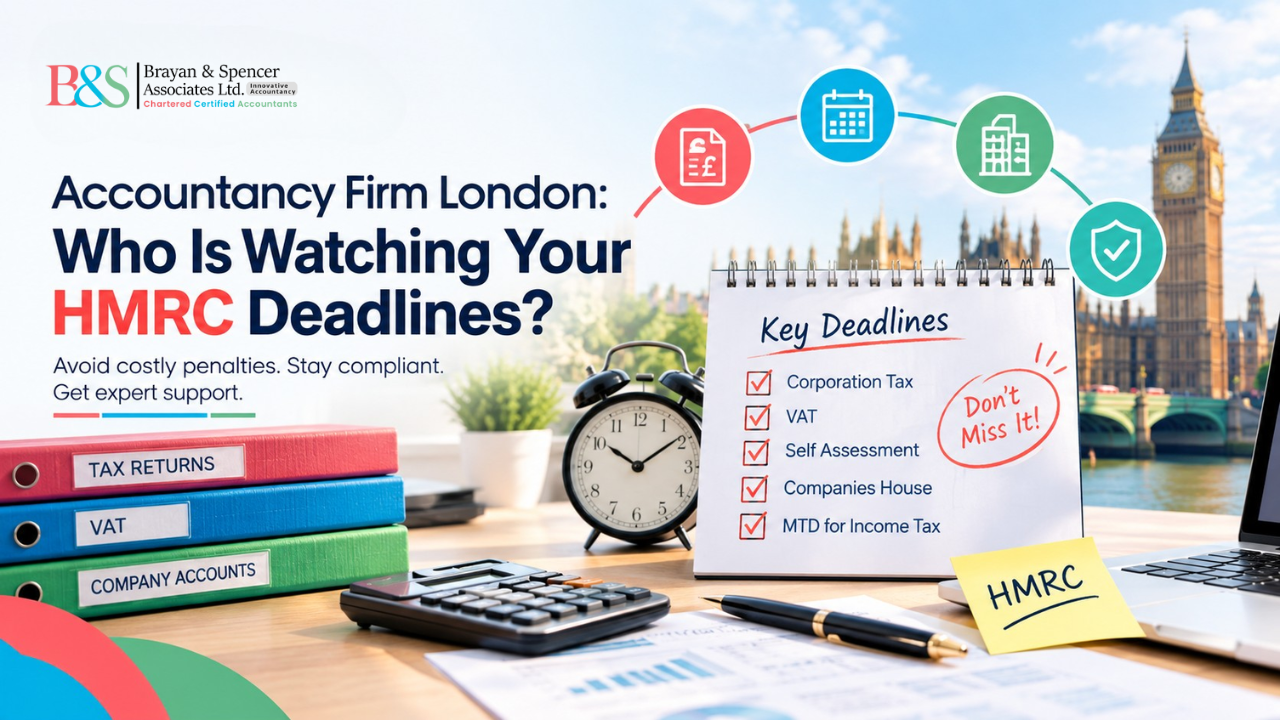
Use this table as a quick test. If your accountant cannot tell you these dates for your company, ask why.
| Deadline | When it is due | Cost of missing it |
| Corporation Tax payment | 9 months and 1 day after year end | Interest from the day after |
| Company Tax Return (CT600) | 12 months after the accounting period ends | £200 from day one, another £200 at 3 months, then 10% charges |
| Companies House accounts | 9 months after year end for private companies | £150 to £1,500, doubled if late two years running |
| Confirmation statement and director ID check | Confirmation statement every year; ID transition ends 18 November 2026 | Filing can be blocked |
| VAT return and payment | 1 month and 7 days after the VAT period | £200 once quarterly filers reach 4 penalty points |
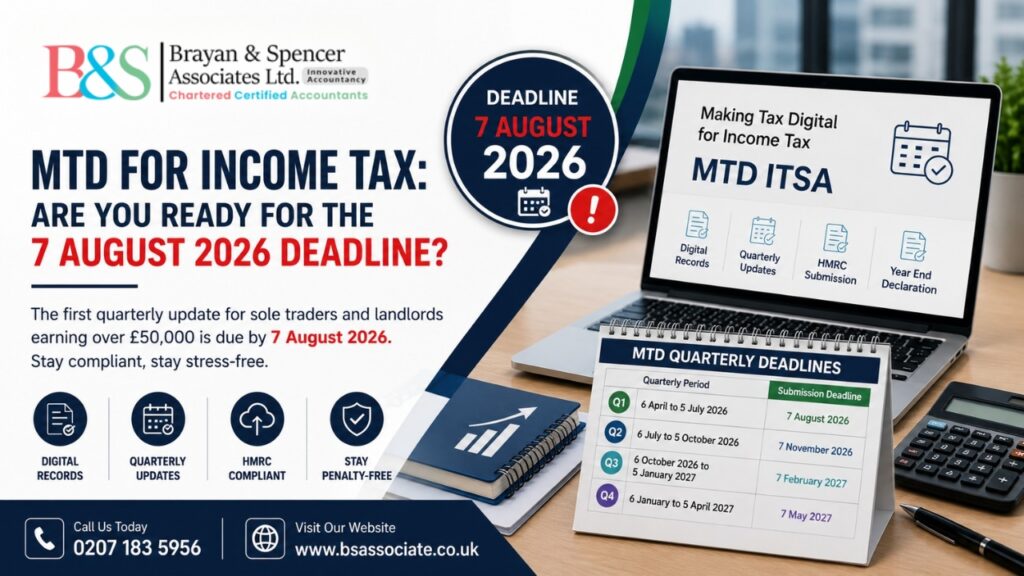
| MTD for Income Tax quarterly update | 7 August, 7 November, 7 February, 7 May | No points in 2026 to 2027, then £200 at 4 points |
| Self Assessment return | 31 January | Late filing and late payment penalties |
The £200 penalty trap
Three HMRC regimes now use a £200 figure, so it is easy to mix them up.
First, the Company Tax Return. GOV.UK now lists a £200 penalty one day after the deadline, plus another £200 at three months. If your return is three times late in a row, each fixed penalty rises to £1,000. HMRC then adds 10% of unpaid tax at six months and again at twelve months.
Second, VAT. Every late return earns a penalty point. Quarterly filers reach the threshold at four points, and a £200 penalty follows. Each further late return adds another £200.
Third, Making Tax Digital for Income Tax. HMRC confirmed that no penalty points apply for late quarterly updates in 2026 to 2027. After that, four points also triggered a £200 penalty. However, late payment and late Self Assessment penalties still apply today.
Because these rules run side by side, one messy year can trigger several charges at once. A good accountant keeps a single calendar for all of them.
Companies House ID checks: the deadline directors forget
Identity verification became a legal requirement on 18 November 2025. That date started a 12 month transition period, so it ends on 18 November 2026, about seven weeks from now.
New directors must verify before they are appointed. Existing directors need a personal code, and it is required when the company files its next confirmation statement. If one director has not verified, that filing cannot go through. The duty sits with each individual, so a company with three directors needs three checks.
Also remember that failing to file accounts or confirmation statements is a criminal offence, and directors can be fined personally. Ask your accountant to confirm each director has verified, using Companies House guidance on identity verification. Our company secretarial team can also support your filings.
Corporation Tax: why profits between £50,000 and £250,000 need planning
The Corporation Tax rates are unchanged for the financial year starting 1 April 2026. Companies pay 19% on profits up to £50,000 and 25% on profits above £250,000. Between those figures, marginal relief gradually lifts the effective rate from 19% to 25%.
Here is the catch. Inside that band, each extra pound of profit is taxed at about 26.5%, because you lose relief as profit rises. That is higher than the main rate itself.
For example, a standalone company with £100,000 of profit pays an effective rate of 22.75%. Those limits are also shared between associated companies. So early planning can change the outcome. Timing of spend, director pay and pension contributions can all affect where your profit lands.
An experienced accountant and tax specialist will model this before your year end, not after it. Our tax advisory team does exactly that.
Do you need Financial Audit Services London?
Not every company needs an audit. For financial years beginning on or after 6 April 2025, a company can usually claim exemption if it meets at least two of three tests:
- Turnover of £15 million or less
- Balance sheet total of £7.5 million or less
- 50 or fewer employees on average
However, exemption is not automatic. Public companies, banks and insurers must still be audited, and subsidiaries of larger groups can lose it. Some directors also choose a voluntary audit because lenders or buyers want independent assurance.
Brayan & Spencer Associates is registered as auditors in the UK by ACCA. So we can check your position and advise whether you need Financial Audit Services London or can safely claim exemption. Our audit day guide explains what to expect.
How to check any London accountant using HMRC guidance
HMRC warns that anyone can call themselves a tax agent, and that it does not regulate agents. So the choice is yours. Use these checks from GOV.UK’s guidance on choosing a tax agent:
- Ask whether they hold recognised qualifications or belong to a professional body
- Confirm they are registered for online access with HMRC and meet HMRC’s agent standards
- Meet the person who will deal with HMRC for you
- Agree fees before work starts
- Check they cover everything you need, such as payroll, VAT or audit
- Never sign a blank return, and never share your HMRC sign in details
Even with an agent, the figures on your return remain your responsibility. That is why a clear, open relationship matters.
What HMRC says about Making Tax Digital right now
In August, HMRC reported that more than 436,000 sole traders and landlords had sent their first quarterly update. From September, HMRC began signing up customers who need MTD for 2026 to 2027 but have not joined yet.
The threshold falls to £30,000 in April 2027 and £20,000 in April 2028. The next quarterly deadline is 7 November 2026. Our guide to what 7 November means for you covers the steps. You can also ask yourself whether your accountant has mentioned MTD penalty points.
How Brayan & Spencer Associates supports London businesses
Our Accounting & Tax Services in London cover the full deadline calendar above. Our accounting services London clients use include bookkeeping, payroll, Self Assessment, statutory and management accounts, VAT and Corporation Tax.
You get a free consultation, in person or by phone. Then we prepare a fixed fee quote tailored to what you need, so you only pay for the support you use.
Ready to stop worrying about deadlines? Call 0207 183 5956 or visit www.bsassociate.co.uk to speak with a London accountancy team today.
Frequently asked questions
An accountancy firm in London prepares your accounts and tax returns, manages bookkeeping, payroll and VAT, files with HMRC and Companies House, and advises on tax planning. A good firm also tracks your deadlines and explains the cost of missing them.
GOV.UK lists £200 one day after the deadline and another £200 at three months. HMRC then adds 10% of unpaid tax at six and twelve months. Three late returns in a row raise each fixed penalty to £1,000.
Private companies normally file within nine months of their financial year end. Late accounts trigger an automatic penalty from £150 to £1,500, and the amount doubles if you file late two years running.
Usually not, if you meet two of three limits: turnover up to £15 million, balance sheet up to £7.5 million, and 50 employees or fewer. However, group structure and company type can remove the exemption.
Yes. Verification became mandatory on 18 November 2025. Existing directors must verify by their next confirmation statement, and the transition period ends on 18 November 2026.
Follow HMRC’s advice. Check qualifications or professional body membership, confirm HMRC online access and agent standards, meet the person handling your tax, and agree fees in writing. You can also read our FAQ page or contact us.