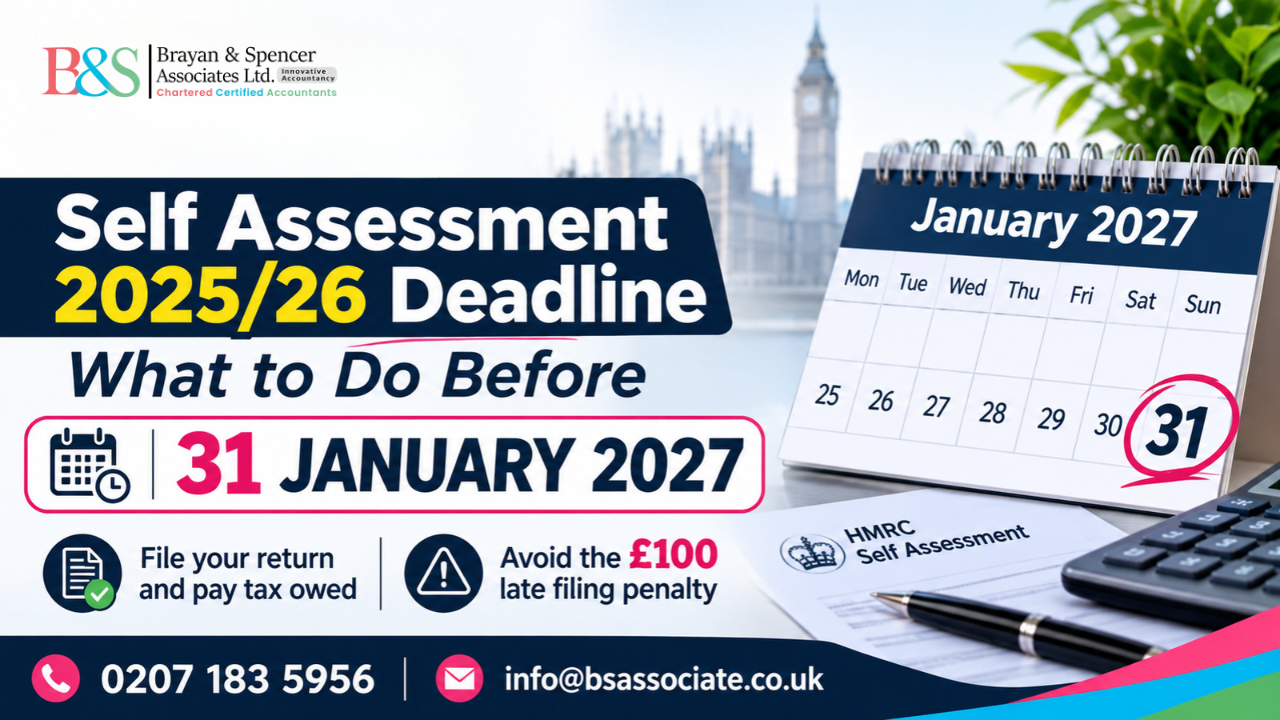
Quick answer: The deadline to submit your 2025/26 online Self Assessment tax return and pay any tax owed is 11:59pm on 31 January 2027. If you want HMRC to collect the bill through your PAYE tax code, file by 11:59pm on 30 December 2026. Filing late means an automatic £100 penalty, even if you owe nothing.
Key takeaways
- The 2025/26 tax year ran from 6 April 2025 to 5 April 2026.
- Filing and paying are two separate deadlines, and both fall on 31 January 2027.
- 31 January 2027 is a Sunday, so don’t plan to finish on the last evening.
- On 31 January you may pay your 2025/26 balance and your first payment on account for 2026/27 together.
- You can file any time from 6 April 2026.
With about ten weeks left, there’s still time to do this calmly. The people who struggle in January are usually the ones who find out in the last week that their HMRC login doesn’t work. Here’s what the deadline covers, who it applies to, and how to get it done in order.
What is the Self Assessment deadline for 2025/26?
HMRC must receive your online return and any tax owed by 11:59pm on 31 January 2027. The paper return deadline was 31 October 2026 and has passed. Online filing is the realistic route now.
| Date | What it means |
| 5 October 2026 | Deadline to tell HMRC you need to file, if you’re new to Self Assessment or didn’t file for 2024/25 |
| 31 October 2026 | Paper return deadline (passed) |
| 30 December 2026 | Last day to file online if you want the bill collected through your tax code |
| 31 January 2027 | Online filing deadline and payment deadline for 2025/26 |
| 31 July 2027 | Second payment on account, where payments on account apply |
If you registered after 5 October 2026, HMRC will give you a later filing date, usually three months from the date of its letter or email. The tax itself is still due by 31 January 2027.
Who needs to file a Self Assessment tax return?
You usually need to file if you have income that isn’t fully taxed through PAYE. In our London practice, that most often means:
- sole traders, freelancers and gig workers
- partners in a business partnership
- landlords earning above the property allowance
- company directors with income beyond their salary
- people with large savings interest, foreign income or capital gains
- anyone with income above the High Income Child Benefit Charge threshold
GOV.UK’s “who must send a tax return” page lets you check your own position. If it’s unclear, a quick call to an accountant will settle it.
What should you do in the 10 weeks before the deadline?
Work through four stages: access, records, figures, then filing and payment. Doing them in this order keeps the final fortnight free for checking rather than scrambling.
1. Check your HMRC access (now to early December). You need your Government Gateway user ID, password and a working way to receive the security code. First-time filers also need a Unique Taxpayer Reference (UTR), which arrives by post and can take a couple of weeks. Log in now, even if you’re not ready to file.
2. Gather your records (early December). Pull together your P60 or final payslip, sales invoices, bank statements, expense receipts, rental income and costs, interest and dividend statements, and pension or charity contributions. Keep your National Insurance number and UTR handy.
3. Work out your figures (mid-December). Add up your income, deduct allowable expenses and check for reliefs. GOV.UK has a Self Assessment tax calculator that gives a rough estimate of the bill, which helps with budgeting. If you want the tax code option, aim to submit before 30 December.
4. File, then pay (January). Read the return carefully, submit it and keep the confirmation. Then arrange payment separately, allowing for bank transfer times. HMRC accepts returns from 6 April 2026, so there’s no reason to wait for the final week.
Two allowances can simplify things. There’s a £1,000 trading allowance and a £1,000 property allowance. If your gross income from either stays below £1,000, you may not need to report it, and above that you can sometimes claim the allowance instead of actual expenses.
What are payments on account, and how do they work?
Payments on account are advance instalments towards your next tax bill. Each one is usually half of your previous year’s Self Assessment bill, and they fall due on 31 January and 31 July. HMRC normally asks for them if your last bill was over £1,000 and less than 80% of your tax was collected at source.
Here’s a simple example. Say your 2025/26 bill is £6,000. On 31 January 2027 you’d pay the £6,000 balancing payment plus a £3,000 first payment on account towards 2026/27, so £9,000 in total. A second £3,000 follows on 31 July 2027.
This catches many first-time filers off guard, so build it into your savings plan. If your income has fallen, you can ask HMRC to reduce your payments on account.
What happens if you miss the 31 January 2027 deadline?
HMRC charges a £100 penalty the day after the deadline, whether you owe tax. Further penalties build up the longer the return is outstanding.
| How late | Late filing penalty |
| 1 day | £100 |
| 3 months | £10 a day, up to £900 |
| 6 months | Further 5% of the tax due or £300, whichever is greater |
| 12 months | Another 5% of the tax due or £300, whichever is greater |
Late payment is charged separately, with interest on unpaid tax and additional percentage penalties as time passes. HMRC may accept a reasonable excuse, such as serious illness or a close bereavement, if you appeal. Forgetting or being too busy is generally not accepted.
If you’ve missed a previous year, file as soon as you can. Each extra month adds cost.
Which mistakes cause the most problems?
Five errors come up repeatedly in our work:
- Leaving out small income. A side project, a rented room or savings interest still needs reporting.
- Claiming private costs as business expenses. Phones, vehicles and home costs attract close scrutiny.
- Overlooking the Child Benefit charge. The income threshold is £60,000, and it still applies above that level.
- Missing pension or charity relief. Without the right entries, you may overpay.
- Filing on time but paying late. The deadlines are separate, and so are the penalties.
How do you spot an HMRC scam?
HMRC will never ask you to share your login details, and you shouldn’t give them to anyone who contacts you unexpectedly. Self Assessment season brings a rise in fake texts, emails and calls claiming you’re owed a refund or face arrest. If a message feels wrong, don’t click the link. Search “HMRC scams” on GOV.UK for the official checklist.
If an accountant files for you, they should be authorised through HMRC’s agent process. You shouldn’t need to hand over your password.
Does Making Tax Digital change your 2025/26 return?
No. Making Tax Digital for Income Tax started in April 2026 for self-employed people and landlords with qualifying income above £50,000, but your 2025/26 return is still filed through Self Assessment by 31 January 2027. If MTD may affect you in future, read our guides on Making Tax Digital for Income Tax and MTD and Self Assessment.
When should you use a Self Assessment accountant in London?
An accountant is most useful when your tax affairs go beyond a single payslip. That includes several income sources, rental property, jointly owned property, share or property sales, a business started this year, or an HMRC letter you don’t understand.
At Brayan & Spencer Associates, our London team prepares and files Self Assessment returns for sole traders, landlords, company directors, partners and private individuals. We’re ACCA-registered, and we’ve supported taxpayers since 2006. We check your figures, look for reliefs, file on time and deal with HMRC if queries arise. You can read more on our Self Assessment tax return accountants in London page, or see our wider taxation services.
Get your 2025/26 return filed before January
Starting now gives you ten weeks of breathing room. Starting in January gives you very little. Call 0207 183 5956 or email info@bsassociate.co.uk, and we’ll tell you what we need, what it will cost and when we can file.
Official sources
- Self Assessment tax returns: Deadlines (GOV.UK)
- Self Assessment tax returns (GOV.UK)
- File your Self Assessment tax return online (GOV.UK)
- Pay your Self Assessment tax bill (GOV.UK)
- Payments on account (GOV.UK)
- Estimate your Self Assessment tax bill (GOV.UK)
Frequently asked questions
Your online return and any tax owed are due by 11:59pm on 31 January 2027.
It’s the last day to submit your online return if you want HMRC to collect your bill through your PAYE tax code. After that, you must pay another way.
Yes. HMRC accepts returns from 6 April 2026. Filing early doesn’t bring the payment date forward, which stays at 31 January 2027.
If you’re required to send a return, yes. A late filing penalty can apply even when there’s nothing to pay.
It’s an advance payment towards next year’s tax bill, usually half of the previous year’s bill, due on 31 January and 31 July.