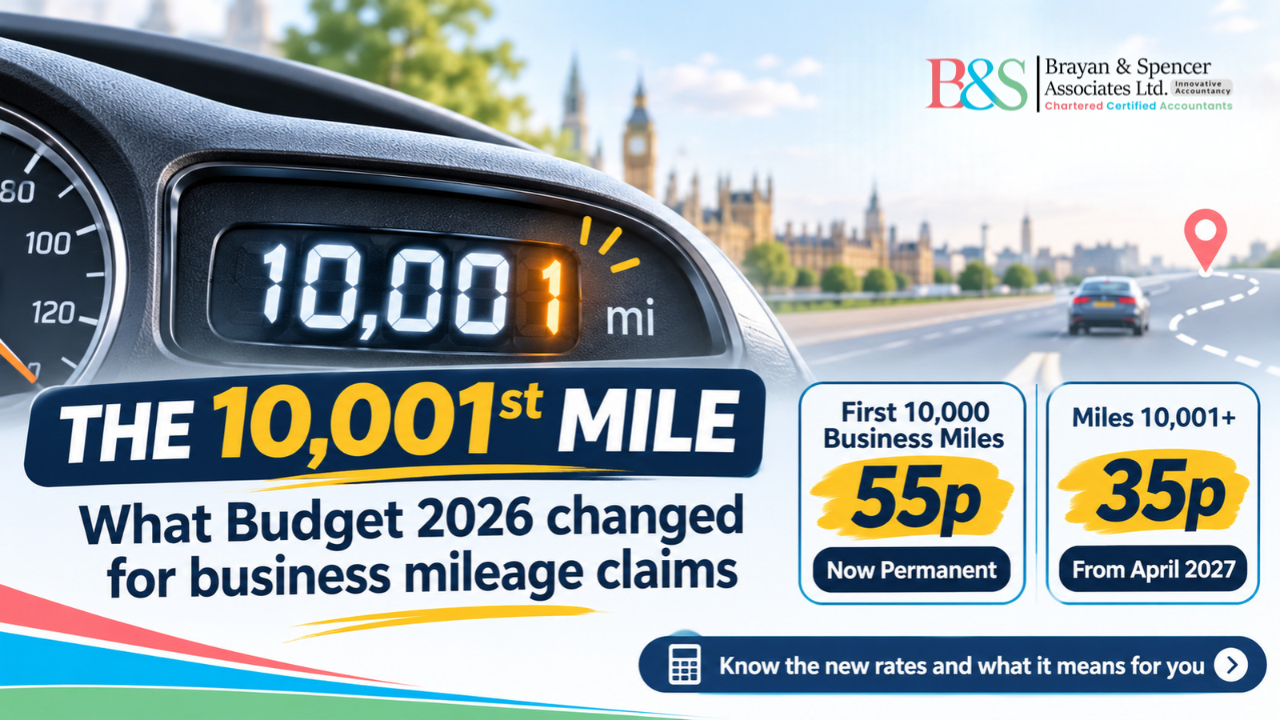
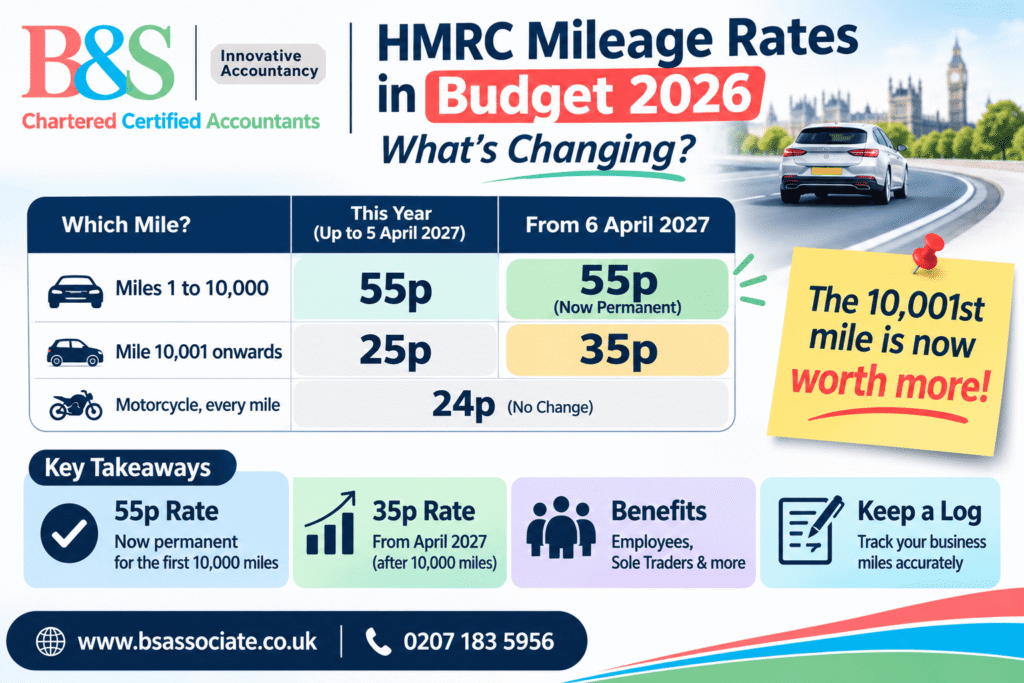
In one breath: 55p a mile for your first 10,000 business miles is now permanent. From 6 April 2027, every business mile after that is worth 35p instead of 25p, for employees and for sole traders using simplified expenses. This tax year is untouched, and the 35p still has to pass through the Finance Bill.
Most of the headlines about the HMRC mileage rate this autumn were about 55p. The line that matters more to anyone who spends their working week behind a wheel sits a little further down the Budget notes: the 10,001st mile of your year has just been given a pay rise.
Earlier in the year we wrote about the jump from 45p to 55p. Think of this article as chapter two. It explains what the Budget added, who benefits, and what is worth sorting out before the new tax year begins.
The two numbers worth remembering
| Which mile? (car or van) | Until 5 April 2027 | From 6 April 2027 |
| Miles 1 to 10,000 | 55p | 55p, now permanent |
| Mile 10,001 onwards | 25p | 35p |
| Motorcycle, every mile | 24p | 24p (no change announced) |
The permanent 55p rate is the quieter of the two changes, but it is useful. It means expense policies, payroll settings and mileage apps can be set once without anyone wondering whether the rate will slide back.
The 35p figure is an announcement, not yet an Act of Parliament. HMRC’s Overview of Tax Legislation and Rates lists each Budget measure and when it is due to be legislated, and it is the document to check on GOV.UK.
Why the 10,001st mile matters
The 10,000-mile line resets every 6 April. That sounds like a technicality until you picture how a busy year actually unfolds.
Imagine a mobile carer who averages 1,500 business miles a month. She reaches 10,000 miles around late October. From then until the following 5 April she is on the lower rate for every single journey.
- Over a full year she drives: 18,000 miles.
- This tax year’s claim: 10,000 × 55p = £5,500, plus 8,000 × 25p = £2,000, so £7,500.
- The same year under the new rate: £5,500 plus 8,000 × 35p = £2,800, so £8,300.
That is £800 more from exactly the same driving. At basic-rate tax it is worth around £160, at higher rate around £320. For a sole trader, National Insurance may add something, so treat those as ballpark figures rather than promises.
How much more, depending on your mileage
| Business miles in the year | Claim at this year’s rates | Same miles at 2027/28 rates | Extra |
| 6,500 | £3,575 | £3,575 | £0 |
| 10,000 | £5,500 | £5,500 | £0 |
| 14,500 | £6,625 | £7,075 | +£450 |
| 18,000 | £7,500 | £8,300 | +£800 |
| 25,000 | £9,250 | £10,750 | +£1,500 |
Two things stand out. If you stay under 10,000 miles, the Budget changes nothing for you. And the benefit grows quickly the further you go past the line, so it is the heaviest drivers who gain most.
Those are typically courier and delivery drivers, community nurses and carers, engineers and tradespeople moving between jobs, sales reps, and anyone doing property visits across several boroughs. For all of them, a tidy mileage log is no longer just good housekeeping. Every extra mile now has a higher value, which also makes it a more attractive one to question.
Employees: the rate is a ceiling, not a promise
Your employer decides what you are actually paid per mile. The Budget figures simply mark the most it can hand over before tax and National Insurance get involved. Plenty of employers pay less, and a few pay nothing at all.
When the amount falls short, the gap is still yours to claim from HMRC as tax relief. Say your employer pays 40p and you drive 9,000 business miles. The gap to 55p is 15p a mile, which is £1,350 of eligible amount. Relief on that is worth about £270 at the basic rate or £540 at the higher rate.
Two conversations are worth having this winter:
- With your employer: ask whether the policy will follow the 35p band from April 2027 or stay where it is.
- With yourself: make sure your log stands up. If HMRC ever asks, a record written at the time beats a reconstruction from calendar entries.
Sole traders and partners: the flat rate is your choice
If you are self-employed you can skip the receipts for fuel, servicing and insurance and simply multiply business miles by the flat rate. It is quick and tidy. It is not automatically the cheapest route, though.
- Flat rate tends to suit lighter use, newer vehicles and people who would rather not keep a folder of garage invoices.
- Actual costs can come out ahead when a vehicle is expensive to run and spends most of its life on business journeys.
- Capital allowances are the sticking point. Once you have claimed them on a vehicle, the flat rate is generally off the table for that vehicle.
- Mixing the two on one vehicle is a double claim, and one that HMRC knows to look for.
HMRC sets out the rules on its simplified expenses page for vehicles. If you earn your living on a platform or in delivery work, our piece on HMRC compliance letters to Uber drivers shows why mileage records attract attention.
Company directors: the company holds the purse
When you drive your own car on company business, the company can repay you at the approved rate without any tax charge. It can also pay less. Pay more than the approved amount and the excess is treated as earnings. The flat-rate method is a sole-trader and partnership tool, so a limited company sits outside it.
That makes the 35p band a policy decision for the board, which in a small company means you. If your payroll software has the old figures baked in, ask the provider when it will be updated, or speak to our payroll team.
Where Making Tax Digital touches your mileage
Motor costs feed into the expenses total in each MTD quarterly update. Because those updates run on a cumulative, year-to-date basis, your software has to count miles from 6 April, not from the start of the latest quarter. Otherwise it may apply 55p to miles that belong in the lower band.
The new tax year on 6 April 2027 brings two things at once: the 10,000-mile counter returns to zero, and the 35p band switches on (assuming the legislation passes as announced).
If you join MTD for Income Tax that same April because your 2025/26 income passed £30,000, mileage will be one of the first things you need to record digitally. Our overview of Making Tax Digital for Income Tax in 2027 covers who is affected, and what to include in your MTD quarterly update shows where motor expenses sit. Already behind on an update? Start with what to do if you missed the 7 November deadline, and keep in mind that your January return is a separate task, explained in Do you still need a tax return if you are in MTD?
Seven jobs for the winter
- Open your software or app and confirm it uses 55p for the first 10,000 miles this year. Some still carry 45p.
- If you keep no log, start one today: date, start point, destination, reason, miles.
- Estimate your annual total. Anywhere near 10,000 and the new band is relevant to you.
- Strip out commuting. Home to a permanent workplace is not business travel.
- Self-employed? Decide, vehicle by vehicle, between flat rate and actual costs.
- Employers: price what paying 35p above 10,000 miles would cost your business.
- Ask your software provider for the date it will switch on the 2027/28 rates.
How to claim your business mileage, step by step
The route to your money depends on how you are paid, so find your own lane.
If you are an employee paid less than the approved mileage rate:
- Add up your business miles for the tax year and multiply them by the approved rate.
- Subtract what your employer actually paid you.
- Claim the difference as mileage allowance relief through your Self Assessment return, or through HMRC’s online employment expenses service if you do not file a return.
If you are self-employed:
- Total your business miles from your log, using the cumulative figure for the year to date.
- Apply 55p to the first 10,000 miles and the lower band to the rest.
- Enter the result as a motor expense in your MTD software or your Self Assessment return, and keep the log with your records.
Whichever route applies, the claim is only as strong as the evidence behind it. HMRC can ask for your records for several years, so file them somewhere you will still find them. If you would rather hand the paperwork to a specialist, our accountant and tax specialist in London team handles mileage claims and the Self Assessment tax return in one place.
Treat 35p as a plan, not a promise
A Budget announcement is not an Act of Parliament. The commentary we reviewed lines up on the permanent 55p and the 35p band from April 2027, but wording can shift between announcement and Royal Assent. We will update this article once the Finance Bill settles the point.
Want a second opinion on your mileage?
Brayan & Spencer Associates helps London employees, sole traders, directors and landlords with mileage claims, taxation, payroll policy and MTD set-up. Bring your log and we will tell you which method looks strongest for you. More guides are in our Making Tax Digital hub and HMRC news section.
Not sure your mileage is set up right for April?
Call us on 0207 183 5956 or send us a message.
Frequently asked questions
Yes. The 28 October Budget made it a standing rate rather than a one-year measure, so it no longer depends on an annual decision.
They stay at 25p for the rest of 2026/27. From 6 April 2027 they move up to 35p, provided the Finance Bill goes through as announced.
The commentary we have seen says yes, and that it covers simplified expenses as well as employee payments. Check HMRC’s legislation overview for the final wording.
No change has been announced. They remain at 24p per mile.
No. The figures are the tax-free ceiling. Your employer can pay less, and you may be able to claim relief on the difference.