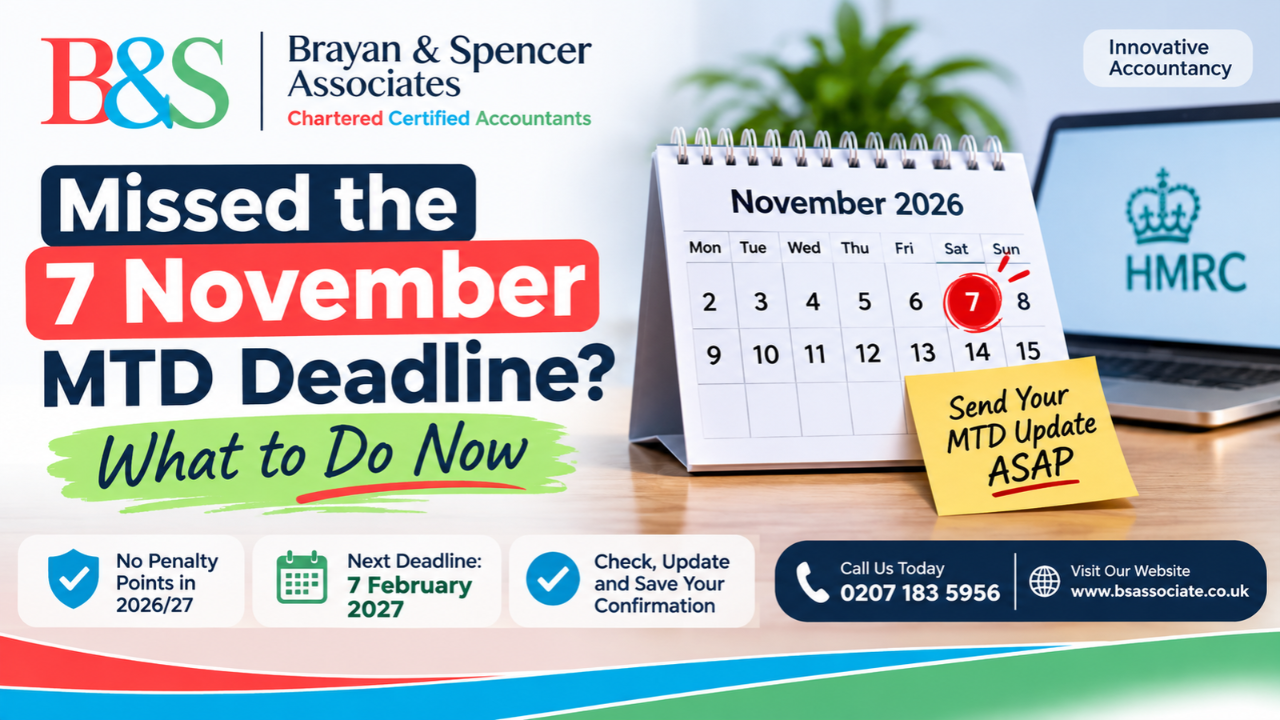
The quick answer: Send your second quarterly update as soon as your figures are right. For 2026/27, HMRC is not issuing penalty points for late quarterly updates, so a missed 7 November is not a financial emergency. It is, though, a nudge to get your routine sorted before penalty points begin in April 2027. You also can’t file your tax return until your quarterly updates are in.
If the 7 November deadline has been and gone and you still haven’t sent your update, you are far from alone. Every deadline we see a wave of people who meant to do it, got busy, hit a software snag or simply weren’t sure what to put in the boxes. This one fell on a Saturday, which didn’t help, and a few days on, some people will already have had a reminder or two from HMRC. Don’t let that rattle you. A few days late is very fixable.
The good news is that a missed update is one of the easier problems to put right. Here is how we would handle it if you were sitting across the desk from us.
First, check that you really did miss it
It sounds daft, but we always start here, because the answer isn’t always what people expect.
Some people never sent anything, and that’s straightforward. Others pressed submit, saw a green tick and assumed all was well. Accountants have reported cases where the software said “success” and the client’s HMRC account even showed the profit and a tax forecast, yet the obligation still looked open. If that’s you, take a dated screenshot of the confirmation and keep it somewhere safe.
The third group sent an update, but it didn’t cover the whole period. The second update has to run from the start of the tax year to the end of the period: 6 April to 5 October 2026 on standard periods, or 1 April to 30 September if you chose calendar periods. Send just the last three months and HMRC may quite rightly leave the obligation open.
If your software wouldn’t let you send at all, our guide to why an MTD quarterly update fails and how to fix it goes through the usual suspects.
Get the records right, then send it
The worst thing you can do now is rush a poor update out just to tick the box. Give yourself an hour and do it properly.
Start with the bank feed and clear anything sitting unreconciled, because that is income or expense that hasn’t reached your figures yet. Pull out anything personal that has crept into business spending; supermarket shops and family subscriptions are the usual offenders. Then check that every income source is there. If you have self-employment and a rental property, each one needs its own update.
And look at the year-to-date totals, not just the latest quarter. Quarterly updates are cumulative: each one replaces the last, so the figures you send now should tell the story of the whole year so far. If you’re unsure what belongs where, what to include in your MTD quarterly update covers it box by box.
Once you’ve sent it, save the confirmation. We can’t stress this enough. A screenshot showing the date and time takes five seconds and has saved plenty of people an argument later.
What if you missed the first update as well?
This is the question we hear most from late starters, and the honest answer has a little nuance. Because updates are cumulative, commentators in the profession have noted that a successful second update covers the year-to-date position, including quarter one. That is a professional view rather than an HMRC statement, though, and some software still asks for the earlier period first. If yours does, send Q1 and then Q2 straight after. It costs you ten extra minutes, not a penalty.
What HMRC will and won’t do about it
Let’s be straight about both sides of this.
On the reassuring side, GOV.UK confirms there are no penalty points for missing a quarterly update deadline in 2026/27. You can read the wording on HMRC’s MTD penalties page. A late update can simply be sent late.
On the other side, none of this lets you off the hook entirely. You still have to send every quarterly update before you can submit your tax return. A late return or a late payment still carries the usual penalties. And from April 2027, each missed quarterly deadline for later tax years earns a point; reach four and you face a £200 penalty.
So think of 2026/27 as a rehearsal with the safety net still up. It won’t stay up.
If HMRC has already written to you
Don’t ignore the letter, but don’t assume it’s right either. These letters don’t distinguish between a genuine miss, a software fault and an HMRC error, and we have seen enough of them to know that not all are justified.
Before replying, check three things. Was the update really submitted, and did it cover the whole period? Does each income source in your software match the right one at HMRC? And has any income stopped? An update can still be due for income that has since ended, which catches a surprising number of people out.
One more thing worth knowing. HMRC has said that some people with more than one eligible income source received a reminder letter even though they had already sent an update for one of them. Its advice is to log in to the Manage Self Assessment online service, which shows the income sources you signed up with, and check which ones still need an update. And if a figure in an earlier update was wrong, HMRC says the correction simply goes into your next quarterly update, so there is no need to resend the old one.
Our guide to responding to an HMRC letter about a missed MTD quarterly update walks through the reply, and if this isn’t your first miss, what happens after missing the 7 August deadline is worth a read.
And if you only found out about MTD when a letter turned up, HMRC has been signing up people it thinks should already be in. Get compatible software connected first; our posts on how to sign up for MTD Income Tax and HMRC auto-enrolment cover the setup.
Don’t let it happen twice
The next update, covering 6 April 2026 to 5 January 2027 (or 1 April to 31 December on calendar periods), is due on Sunday 7 February 2027. It lands a week after the 31 January tax return deadline, which is a recipe for a bad fortnight. We’ve set out how to handle both in our guide to the 31 January and 7 February double deadline.
The fix that works for nearly everyone is boring. Do your bookkeeping monthly, not quarterly; twenty minutes every month beats a weekend of panic every three. Put reminders in the diary for a week before, three days before, and a “send it” day on the Thursday or Friday. Never plan to submit on the last day, because that is exactly when systems are slowest and when something unexpected tends to happen.
If you’re one of the people joining MTD from April 2027 because your 2025/26 income was over £30,000, use this winter as practice. Making Tax Digital for Income Tax in 2027 sets out what changes and when.
When we’d suggest picking up the phone
Plenty of people can sort a missed update themselves. We’d get someone involved if you’ve missed more than one, if you have several income sources or jointly owned property, if HMRC has written and you aren’t sure what to say, or if your software simply won’t connect. And honestly, if you’d rather someone else owned the calendar from here on, that’s a perfectly good reason too.
Brayan & Spencer Associates is a London firm that handles MTD software setup, bookkeeping catch-up and quarterly submissions for sole traders and landlords. You’ll find more guides in our Making Tax Digital hub.
Missed the deadline and not sure where you stand?
Call us on 0207 183 5956 or send us a message. Tell us what happened and we’ll tell you the quickest way back on track.
Frequently asked questions
For 2026/27, HMRC isn’t charging penalty points for late quarterly updates. Send the update as soon as you can, because all quarterly updates must be in before you can file your tax return.
Yes. Because updates are cumulative, a late one still covers your whole year to date.
Not necessarily. Professional commentary suggests a successful second update covers the year-to-date position, including quarter one, but some software asks for earlier periods first. Follow what yours requires.
Not with a penalty point this tax year. Penalties for late tax returns and late payments still apply, and from April 2027 four penalty points bring a £200 penalty.
The third quarterly update is due on 7 February 2027.