
Short answer: Almost certainly yes, and there is a detail in how the system works that most people in your position do not find out until it is too late to prepare properly.
If your gross income from self-employment and property combined exceeded £50,000 in the 2024/25 tax year, Making Tax Digital for Income Tax has applied to you since 6 April 2026. The first quarterly submission deadline is 7 August 2026. But the part that tends to catch mixed-income earners off guard is not the deadline itself. It is how the reporting works once you are in the system, and it is meaningfully different from what most people expect.
This post covers exactly how MTD for Income Tax works when you have both rental income and self-employment income: how HMRC calculates your qualifying income, why you submit more than four updates a year, what goes into each submission, and what the Final Declaration looks like when your income comes from multiple directions.
At Brayan & Spencer Associates, we handle MTD compliance for mixed-income clients across London, including the setup, all quarterly submissions, and the year-end declaration. We also provide free accounting software as part of the package. If you want to get sorted now, call us on 0207 183 5956 or visit www.bsassociate.co.uk.
How HMRC Calculates Qualifying Income When You Have Both Sources
This is where most mixed-income earners make their first mistake: they look at each income stream separately and decide neither one on its own crosses the £50,000 threshold, so MTD must not apply. That is the wrong way to read the rules.
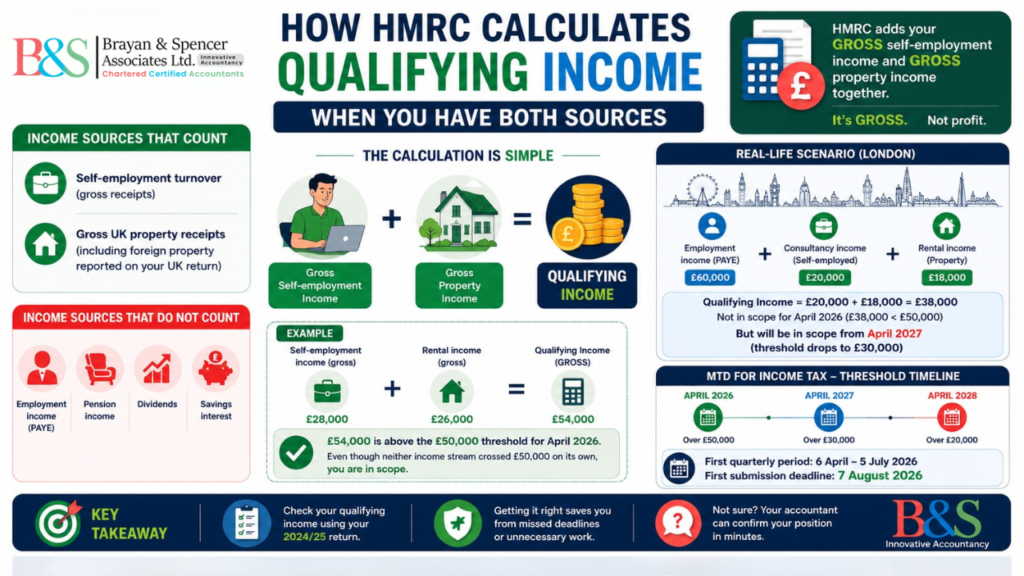
HMRC adds your gross self-employment income and your gross property income together to arrive at your qualifying income. Gross means total receipts before expenses. Not profit. Not what you keep after deducting your mortgage interest, letting agent fees, business costs, or anything else. The full amount that came in.
So if you earned £28,000 from freelance work and received £26,000 in rental income in 2024/25, your qualifying income is £54,000. Both income streams combined put you above the £50,000 threshold for the April 2026 mandate, even though neither one crossed it alone. HMRC looks at the combined figure from your 2024/25 Self Assessment return and that is what triggers your mandation date.
The income sources that count toward qualifying income are self-employment turnover and gross UK property receipts, including income from foreign property if it appears on your UK return. The income sources that do not count are employment income through PAYE, pension income, dividends, and savings interest. A common scenario in London: someone earns £60,000 from employment, £20,000 from a side consultancy, and £18,000 from a buy-to-let. Their qualifying income is £38,000 the consultancy and rental combined, not the employment. They are not in the April 2026 mandate, but they will be caught by the April 2027 threshold drop to £30,000.
Getting this calculation right matters because making the wrong assumption in either direction has consequences. Assuming you are not in scope when you are means missing the August deadline and operating without compliant digital records. Assuming you are in scope when you are not means unnecessary work. If you are not certain of your qualifying income figure, your accountant can confirm it from your 2024/25 return in minutes.
The Part That Surprises Most People: How Many Submissions You Actually Make
Here is what trips up almost everyone with both rental and self-employment income: you do not submit four quarterly updates per year under MTD for Income Tax. You submit eight.
HMRC treats self-employment income and property income as separate businesses for MTD purposes. Each income source requires its own set of quarterly updates. If you have one sole trade and one property business, that is four updates per source, per quarter, totalling eight quarterly submissions every year, plus a single Final Declaration. If you run two separate sole trader businesses alongside a rental portfolio, that rises to twelve quarterly updates plus the Final Declaration.
This is a fundamental point that the broad-brush MTD coverage rarely explains clearly. When your accountant or HMRC documentation refers to “four quarterly updates a year,” that figure assumes a single income source. With mixed income, the correct number is higher.
The practical impact is less alarming than it sounds. Your MTD-compatible software manages both sets of submissions within the same platform. You do not log in to two separate systems or deal with two different processes. The software tracks your self-employment income and expenses in one area and your property income and expenses in another, then submits both sets of quarterly updates to HMRC on time. The additional submissions add almost no extra work once your records are being captured digitally and regularly. What they do require is that your software is set up correctly from the start to separate the two income streams, and that you or your accountant are clear on which receipts and expenses belong to which source.
What Each Quarterly Submission Covers
The content of each quarterly update is the same whether it covers your self-employment or your rental income. It is a summary of the income received and the allowable expenses incurred during that three-month period, submitted digitally through HMRC-recognised software.
For your self-employment submission, this means your freelance or business turnover for the quarter and your allowable business costs categorised by type: travel, office costs, professional fees, software subscriptions, equipment, and similar. For your property submission, this means your gross rental receipts for the quarter and your allowable property expenses: letting agent fees, repairs and maintenance costs, buildings insurance, and other deductible items. Mortgage interest is handled separately at the Final Declaration stage under the rules introduced after Section 24 changes for residential landlords.
Neither submission is a tax return. No tax is calculated, no payment is required, and no adjustments for reliefs or allowances are made at this stage. HMRC uses the quarterly updates to track your income position throughout the year, but the actual tax calculation happens later at the Final Declaration.
One point worth noting on expenses: for UK property income, HMRC allows you to report income each quarter and catch up on expense reporting in your final submission if that is easier to manage. This flexibility exists specifically for landlords who find it more practical to collate property expenses annually. Speak to your accountant about whether this suits your record-keeping approach.
What Counts as a Separate Business Under MTD
Understanding what HMRC treats as a separate business matters because it determines how many sets of quarterly updates you submit.
UK property income is treated as a single business regardless of how many properties you own. If you have three buy-to-lets, one set of quarterly updates covers all three combined. You report the total rental receipts and total allowable expenses across the whole portfolio, not property by property. This is a meaningful simplification for portfolio landlords who might otherwise have feared a separate submission for each property.
Overseas property income is treated as a separate business from UK property income. If you have both UK and overseas rental income, that creates a third income stream requiring its own set of quarterly submissions.
Self-employment income is assessed per trade. If you operate one sole trader in business, say, a consultancy practice that is one set of quarterly updates. If you operate two genuinely separate sole trader businesses, a consultancy and a photography business, for example HMRC treats those as two separate businesses, each requiring its own quarterly submissions.
The practical upshot for the most common scenario of one sole trade and one UK property portfolio is eight quarterly submissions per year and one Final Declaration. That is the starting point for most mixed-income clients.
How the Final Declaration Brings Everything Together
After the four quarterly update deadlines pass, you must submit the Final Declaration for the tax year by 31 January following the end of that year. For 2026/27, that deadline is 31 January 2028.
The Final Declaration is where MTD replaces the old Self-Assessment tax return. It pulls together the figures from all your quarterly updates across every income source and is where you make year-end adjustments capital allowances, mortgage interest relief on property income, overlap profits for sole traders, and any other reliefs and allowances you are entitled to claim. It also includes any income that does not fall within the MTD reporting system: PAYE employment income, pension income, savings interest, dividends.
Once submitted, the Final Declaration triggers your final tax liability calculation for the year. The payment deadlines remain the same as under Self Assessment: the balancing payment for 2026/27 is due 31 January 2028, with payments on account due 31 January and 31 July if applicable.
The key difference from the old system is that by the time the Final Declaration is due, HMRC already has your income and expense summaries from all four quarters. The end-of-year process becomes a confirmation and adjustment exercise rather than a full reconstruction of twelve months of activity from scratch.
A Practical Example
A London-based marketing consultant earns £36,000 from freelance client work and receives £22,000 in gross rental income from a buy-to-let flat in East London. Their qualifying income is £58,000 both sources combined before expenses. They are in the April 2026 mandate.
Each quarter, they submit two updates: one covering their consultancy income and business expenses, and one covering their rental receipts and property costs. Their MTD-compatible software handles both. Their accountant connects the software to HMRC, manages the submissions each quarter, and prepares the Final Declaration by January 2028 incorporating mortgage interest relief, any capital allowance claims on consultancy equipment, and their full income picture including some PAYE income from a single employed day a week.
Before MTD, this person filed one Self Assessment return every January covering all the above. Under MTD, they pass records to their accountant quarterly, the accountant submits eight updates per year, and the January process is considerably lighter because most of the year’s data is already in the system.
How Brayan & Spencer Associates Can Help
Managing MTD compliance across multiple income sources is precisely where working with an accountant pays for itself most clearly. The record-keeping, the software configuration, the split between income streams, and the deadline management all require a setup that is right from day one.
We work with mixed-income clients across London consultants with buy-to-lets, tradespeople with multiple properties, freelancers building a property portfolio alongside their main work. We set up your MTD software to handle each income source correctly, manage all quarterly submissions on your behalf, and prepare your Final Declaration at year end.
As part of our service, we provide free accounting software to clients. There is no additional cost for the platform itself, and no need to research or trial different products. We connect it to HMRC, configure it for your income types, and handle everything from there.
Call us on 0207 183 5956 or visit www.bsassociate.co.uk to speak with our team. If your 7 August 2026 deadline is approaching and you are not yet set up, we can have you compliant quickly.
FAQ
Yes, if the combined gross total does. HMRC adds your gross self-employment income and gross property receipts together to calculate qualifying income. If that combined figure exceeded £50,000 in your 2024/25 Self Assessment return. You are mandated from April 2026 regardless of how each source looks in isolation.
No. Most MTD-compatible software platforms manage both income streams within the same account. You record self-employment transactions in one area and property transactions in another. And the software submits the correct update to HMRC for each source. Your accountant can advise on whether your chosen platform handles both types well.
No. HMRC treats all UK property income as a single business under MTD. You submit one set of quarterly updates covering the combined income and expenses across your entire UK property portfolio. Only overseas property is treated as a separate business from UK property.
No. Employment income through PAYE does not count toward qualifying income and does not appear in your quarterly updates. It is declared at the Final Declaration stage. Where your total income picture MTD sources and non-MTD sources combined is confirmed and your final tax liability calculated.
In most cases, yes. Your accountant needs to be set up with an HMRC Agent Services Account to submit MTD updates on your behalf. At Brayan & Spencer Associates, we are already fully set up for MTD agent submissions. If you are currently with another firm and are unsure whether they are ready for MTD. It is worth asking them directly before the August deadline.