Most UK business owners think Making Tax Digital (MTD) just means switching from spreadsheets to software and submitting tax updates online. It sounds straightforward to enter your numbers, click submit, and you’re done.
But in reality, it’s not that simple.
Making Tax Digital for Income Tax changes how you manage your finances throughout the year, not just at tax time. It expects your records to be accurate, up to date, and easy to explain at any point, not just when your accountant asks them.
And this is where many businesses are struggling.
They have the software. They are submitting updates.
But behind the scenes, their data is incomplete, inconsistent, or unclear.
This blog explains the real challenges most businesses don’t see coming and what you need to get right under MTD.
What MTD Really Requires
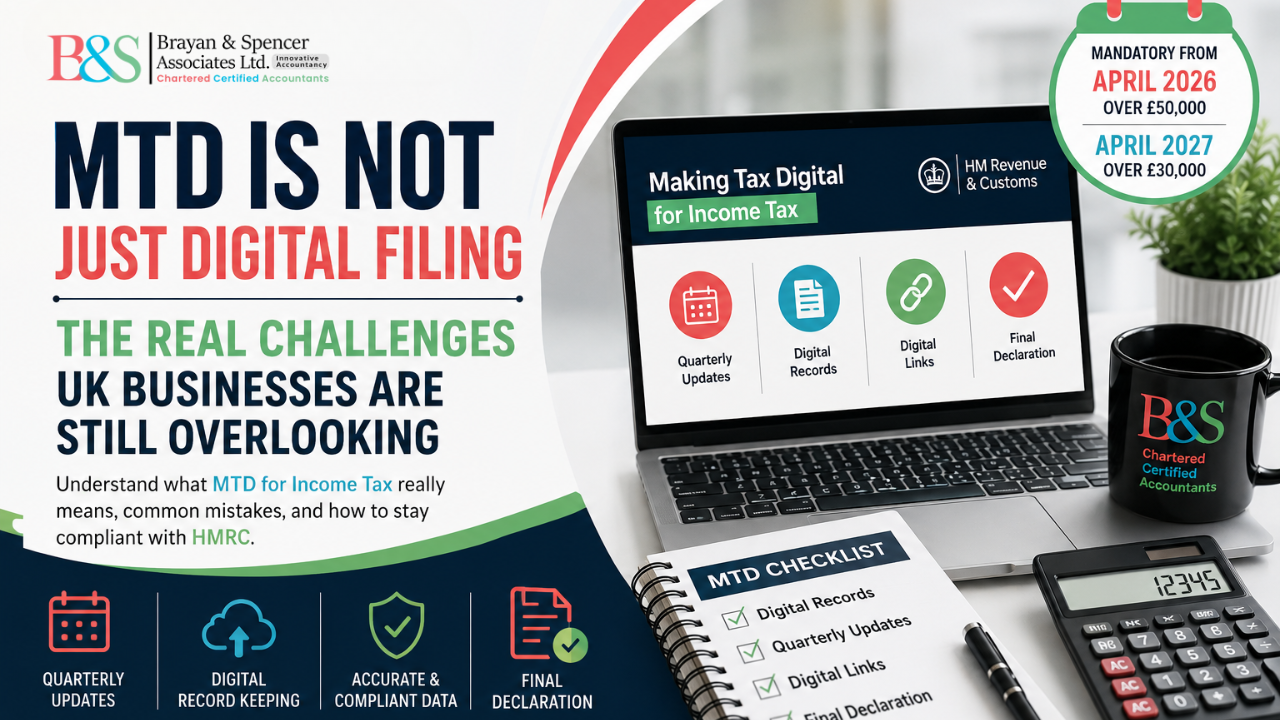
At a basic level, Making Tax Digital for Income Tax (ITSA) requires:
- Keeping digital records
- Using compatible software
- Sending quarterly updates
- Submitting an end of period statement
With the mandate affecting sole traders and landlords with gross income over £50,000 from April 2026, and those over £30,000 from April 2027, the scope is expanding quickly.
But the real shift goes further than the process.
Under expectations set by HM Revenue and Customs, businesses must ensure:
- Records are complete and accurate
- Data flows digitally without manual breaks
- Every figure can be traced back to its source
This creates a new level of responsibility. It is no longer about submitting numbers. It is about being able to explain and support them if questioned.
The Biggest Misunderstanding: “Software Means Compliance”
One of the most common issues businesses face is assuming that using MTD compatible software automatically makes them compliant.
It does not.
Software depends entirely on the quality of data entered. If:
- Income is missed
- Expenses are misclassified
- Transactions are delayed
Then the output will still be incorrect.
A typical example:
A contractor records personal expenses as business costs. The software processes it without error. The quarterly update is submitted. Everything looks fine.
But the underlying data is wrong, and that mistake repeats multiple submissions.
MTD does not remove human error. It amplifies it if it is not managed properly.
Quarterly Reporting: Where Problems Start Showing
Before Making Tax Digital (MTD), many businesses relied on year end adjustments. Records were often cleaned up once a year with the help of an accountant.
Now, with quarterly reporting:
- Issues surface earlier
- Errors get repeated if not corrected
- Inconsistencies become more visible
Quarterly submissions are not final tax returns, but they still need to be based on reasonable and consistent data.
If your process is weak, MTD doesn’t fix it it exposes it multiple times a year.
The Hidden Risk of Poor Record Keeping
Good record keeping is no longer optional under Making Tax Digital for Income Tax.
Common real-world issues include:
- Recording transactions weeks or months late
- Missing receipts or invoices
- Mixing personal and business spending
- Using inconsistent categories
These habits create unreliable data.
And once unreliable data enters your system, every report, update, and submission based on it becomes questionable.
Digital Records Without Structure Create Confusion
Many businesses believe that as long as records are digital, they are compliant.
But digital does not mean organised.
Problems often seen:
- Duplicate entries across different tools
- Random naming of expense categories
- No consistent process for recording income
This leads to data that is technically stored, but practically difficult to review or explain.
Under MTD, clarity matters just as much as compliance.
Broken Digital Links: A Risk Most Businesses Ignore
A key requirement under Making Tax Digital (MTD) is maintaining digital links between systems.
This means data should move between tools without manual copying or re-entry.
However, many businesses still:
- Export data into spreadsheets
- Adjust figures manually
- Re-enter final numbers into software
This breaks the audit trail.
And when the audit trail is broken, it becomes harder to:
- Justify figures
- Track changes
- Respond to queries
The “Fix It Later” Approach No Longer Works
Under the old system, businesses often relied on year-end corrections.
That approach is no longer effective.
With MTD for Income Tax (ITSA):
- Data is submitted throughout the year
- Errors build over time
- Fixing issues requires revisiting multiple submissions
Instead of correcting one set of records, businesses may need to review and adjust for several periods.
This increases both effort and risk.
Compliance vs Confidence: The Real Gap
Many businesses are technically compliant. They:
- Submit updates on time
- Use approved software
- Follow the process
But still feel uncertain about their numbers.
This is the real issue.
Compliance does not always mean confidence.
If you are unsure whether your data is accurate, then the process is not fully working even if submissions are being made.
What Actually Works Under MTD
To manage Making Tax Digital for Income Tax effectively, businesses need to shift their approach:
1. Maintain Records Regularly
Update records weekly or monthly instead of waiting until deadlines.
2. Focus on Accuracy, Not Just Submission
Check data before submitting, not after.
3. Keep Systems Connected
Use tools that integrate properly to maintain digital links.
4. Standardise Your Process
Use consistent categories and methods for recording transactions.
5. Get a Second Layer of Review
Working with an MTD-compliant accountant can help identify issues early and improve accuracy.
Conclusion
Making Tax Digital (MTD) is not just about submitting tax data online. It is about building a system where your financial records are accurate, consistent, and reliable throughout the year.
The real challenge is not using software it is changing how you manage your data.
Businesses that focus only on compliance may meet the requirements but still struggle with errors and uncertainty.
Those who focus on accuracy and process will find MTD far more manageable.
A Practical Next Step
If you are preparing for Making Tax Digital for Income Tax, take a step back and review your current process:
- Are your records updated regularly?
- Can you trace your figures easily?
- Do you trust the numbers you are submitting?
If the answer is unclear, it may be worth getting clarity now rather than fixing issues later.
You can explore practical guidance at www.bsassociate.co.uk or speak directly on 0207 183 5956.
The aim is not just to meet requirements, but to make sure your financial data actually works for you, not against you.
People Also Ask (MTD for Income Tax – UK)
Making Tax Digital (MTD) requires UK sole traders and landlords to keep digital records and submit quarterly tax updates to HMRC using compatible software. A final yearly declaration is still required.
No. MTD also requires accurate bookkeeping, correct expense categorisation, regular record updates, and digital compliance with HMRC rules.
MTD for Income Tax applies to UK sole traders and landlords earning over £50,000 from April 2026 and over £30,000 from April 2027.
Yes. HMRC allows corrections to quarterly updates before the final declaration is submitted. However, repeated errors may increase compliance risks.
Incorrect MTD records may lead to tax miscalculations, HMRC penalties, late filing issues, or compliance checks.
No. Making Tax Digital changes how income is reported during the year, while Self Assessment remains part of the final annual tax declaration process.
HMRC requires compatible MTD software that can maintain digital records and submit updates directly to HMRC systems.
HMRC introduced Making Tax Digital to reduce tax errors, improve reporting accuracy, and modernise the UK tax system through digital record keeping.
Businesses should keep digital records of sales, income, expenses, invoices, and property income to meet HMRC Making Tax Digital requirements.