
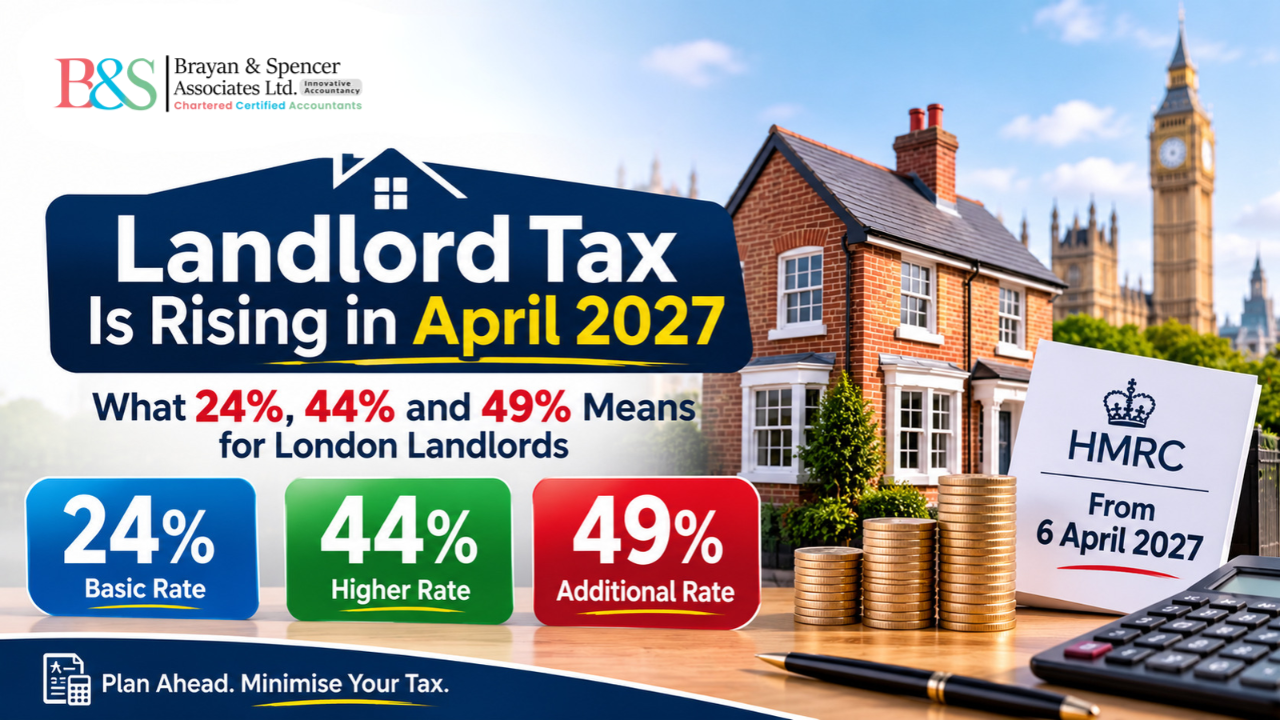
Quick answer: From 6 April 2027, income tax on property income rises to 24% (basic), 44% (higher) and 49% (additional), according to HMRC’s policy paper published on 29 October 2026. That’s four percentage points more than today’s rates, after a further two-point rise was announced at the Autumn Budget on 28 October 2026. The increase covers rental income from the 2027/28 tax year onwards, so your 2026/27 income is still taxed at current rates.
Key takeaways
- Property income has its own tax rates, separate from the rates on salary and other earnings.
- The new rates apply from the 2027/28 tax year, not to rent you’ve already earned.
- A higher-rate landlord with £20,000 of profit pays roughly £800 more a year.
- HMRC says you’ll report the income through the existing Self Assessment or PAYE routes, with no new reporting requirements.
- Making Tax Digital for Income Tax widens in April 2027, with the income threshold dropping to £30,000.
If you let out a flat in Zone 3, a house in Croydon or a couple of buy-to-lets you’ve held for fifteen years, this Budget changes the maths. It doesn’t change it overnight, which is exactly why now is a good time to look at it. Landlords who plan ahead have options. Those who find out when the bill arrives in January 2029 mostly have regrets.
What exactly has changed for landlords?
Budget 2025 announced that the rates on property income would rise by two percentage points from April 2027, to 22%, 42% and 47%. The Autumn Budget 2026 added a further two points from the same date. HMRC’s policy paper sets out the final rates, which will be legislated for in Finance Bill 2026–27.
| Band | Property income rate now | From 6 April 2027 |
| Basic | 20% | 24% |
| Higher | 40% | 44% |
| Additional | 45% | 49% |
A property trust rate of 49% also applies from the same date. The paper says the changes will affect individuals and partnerships who receive income from letting property, as well as trustees and personal representatives who receive property income.
For individuals, the property rates apply in England, Wales and Northern Ireland. The Scottish and Welsh governments have been given the ability to set property income rates under their existing income tax powers, so the position for Scottish and Welsh taxpayers could differ. Savings income is also taxed at 24%, 44% and 49% from April 2027, and those savings rates apply across the UK. Rates on salary and other earnings aren’t changing.
When does the new rate start to bite?
The rates apply from the 2027/28 tax year, which starts on 6 April 2027. In practice:
- 2026/27 return (the year ending 5 April 2027): taxed at current rates, filed by 31 January 2028
- 2027/28 return (the year starting 6 April 2027): taxed at the new rates, filed by 31 January 2029
HMRC’s own costings reflect that timing. The paper shows the extra tax raised from the property change as £35 million in 2027/28, rising to £575 million in 2028/29. That’s the year the first bills at the new rates are due to be settled.
So the first bill at 24%, 44% or 49% is still more than two years away. But the decisions that influence it, such as how you own property, how you split rental profit and what you spend on the property, are best made before the tax year begins.
How much more tax will you actually pay?
The rate only applies to taxable profit, not to the rent you collect. A quick example shows the effect.
| Landlord | Rental profit | Tax at current rate | Tax from April 2027 | Difference |
| Basic-rate taxpayer | £10,000 | £2,000 (20%) | £2,400 (24%) | +£400 |
| Higher-rate taxpayer | £20,000 | £8,000 (40%) | £8,800 (44%) | +£800 |
These figures are simplified and ignore allowances, other income and how your profit falls across the bands. HMRC’s own estimate is that around 5% of taxpayers will see an average rise of £225 a year in 2027/28 from the property change, and that 2.4 million landlords will face a change in tax by 2031/32. The 49% rate applies only to income within the additional-rate band, so it doesn’t mean every landlord pays 49% on all their rent.
Why does this matter more for some landlords than others?
The impact is uneven. You’re likely to feel it most if:
- you’re a higher-rate taxpayer with significant rental profit
- you own property personally or through a partnership rather than a company
- you carry mortgage debt, because interest relief for individual landlords works differently from ordinary business costs
- your rental profits are growing as rents rise while your tax thresholds stay frozen
Landlords with modest profits and a basic-rate income will still pay more, but the pound figure is smaller.
What should London landlords do before April 2027?
Planning here is about being deliberate rather than reactive. These are the areas we’d look at with a client.
1. Work out your real profit.
Add up your 2026/27 rent and allowable costs now, while there’s still time to act. That gives you a clear starting point for 2027/28 rather than a guess.
2. Check your expenses.
Repairs, letting agent fees, insurance, ground rent, service charges and accountancy fees are the usual allowable costs. Improvements are generally treated differently from repairs. Keep invoices that show what the work was for.
3. Review how the property is owned.
For jointly owned property, the way profit is split between owners affects who pays which rate. Our guide to joint property ownership and UK tax rules explains how that works. Some landlords consider holding property through a company. That route carries its own costs, including Stamp Duty Land Tax and Capital Gains Tax on a transfer, and it isn’t right for everyone. Get the numbers run properly before acting.
4. Look at mortgage interest.
Individual landlords can’t deduct mortgage interest as an ordinary expense. They receive a tax reduction instead. It’s worth checking how that relief sits alongside the new rates in your own situation.
5. Prepare for Making Tax Digital.
Making Tax Digital for Income Tax applies from April 2026 to self-employed people and landlords with qualifying income over £50,000. From April 2027, the threshold drops to £30,000. If your gross property income is heading toward that level, you’ll need digital records and quarterly updates. Our guide to Making Tax Digital for sole traders and landlords covers what that involves.
6. Tidy your records.
Keep rent receipts, tenancy agreements, repair invoices and bank statements in one place. Clean records make your return faster and your claims easier to defend.
What about selling a property?
A higher tax rate on rental profit can change the case for holding a property. But selling brings its own tax charge. Capital Gains Tax can be due on the gain, and in most cases a UK residential property sale has to be reported to HMRC within a set period after completion. Selling only makes sense after you’ve compared the tax on selling with the tax on holding. We’d always suggest a calculation first.
Is anything still to be confirmed?
The rates are announced, and HMRC’s policy paper says legislation will be introduced in Finance Bill 2026–27. Until the bill completes its passage through Parliament, the final wording could still change. It’s sensible to plan around the announced rates and keep an eye on official updates. Our advice is to review your position now and revisit it when the legislation is final.
What should you do with your 2025/26 return?
Your current 2025/26 Self Assessment return, due by 31 January 2027, isn’t affected by the April 2027 rate change. If you let out property, make sure your rental income and expenses are complete before you file. Our Self Assessment 2025/26 deadline guide has the timeline.
Need a property tax accountant in London?
At Brayan & Spencer Associates, we work with landlords across London on rental income, expenses, ownership structures and Self Assessment. We’re ACCA-registered, and we’ve supported taxpayers since 2006. We can model what the 2027/28 rates mean for your property portfolio and tell you plainly whether any change is worth making.
Explore our property tax accountants in London page or our property tax specialist service. Or call 0207 183 5956, or email info@bsassociate.co.uk, to book a landlord tax review before April.
Official sources
About the author: Pat Sharma FCA, ACCA is a chartered accountant at Brayan & Spencer Associates, advising landlords, sole traders, company directors and private individuals on Self Assessment, property tax and HMRC compliance.
Frequently asked questions
24% for basic-rate, 44% for higher-rate and 49% for additional-rate taxpayers. The property trust rate is also 49%.
They take effect for the 2027/28 tax year, which starts on 6 April 2027.
No. Income for the 2026/27 tax year is taxed at current rates. The new rates apply from the 2027/28 tax year.
No. The 49% rate only applies to income within the additional-rate band. Most landlords will pay the basic or higher rate.
HMRC says the property rates apply to individuals in England, Wales and Northern Ireland. The Scottish and Welsh governments have the ability to set their own property income rates, so check the latest position for your area.
No. HMRC says there are no changes to reporting requirements. You report and pay through existing Self Assessment or PAYE channels.
No. HMRC’s earlier guidance confirms the property allowance and the Rent a Room Scheme remain unchanged.