

If HMRC has written to you about undeclared property income, foreign income, or a possible tax shortfall, do not ignore it. The way you respond in the next few weeks will determine how much you pay and whether the matter escalates into a full investigation.
Why HMRC Is Sending More Letters Than Ever in 2026
Opening an unexpected letter from HMRC is unsettling. Whether it asks about rental income from a property you let out, overseas accounts, foreign investments, or income you did not realise needed declaring, the feeling is the same: uncertainty, worry, and the immediate question of what to do next.
You are not alone. HMRC sent over 10,000 nudge letters in 2025 under the Let Property Campaign alone, and that number has risen sharply in 2026. The reason is the data. HMRC now has access to information sources that simply did not exist a few years ago. Airbnb, Booking.com, and other short-term letting platforms have been required to report landlord earnings to HMRC since January 2024 under DAC7 international reporting rules. Land Registry records, tenancy deposit schemes, and bank transaction data are routinely cross-referenced with submitted tax returns. Overseas tax authorities in more than 100 countries automatically share financial account information with HMRC under global transparency agreements.
If your income from property or overseas sources does not match what HMRC can see in its data, a letter follows.
At Brayan & Spencer Associates, our property tax advisors in London work with landlords, property investors, and individuals with overseas income who have received HMRC letters and need expert support to resolve their situation quickly and correctly. Call us on 0207 183 5956 or visit www.bsassociate.co.uk for a confidential conversation today.
What Types of HMRC Letters Are Being Sent?
Understanding which type of letter you have received matters, because your response options differ depending on the category.
Nudge letters are the most common. These are not formal investigations. HMRC writes to say it holds information suggesting you may have income that has not been declared. You are invited to check your records and, if income is outstanding, to come forward voluntarily. A nudge letter is pre-enquiry, which means you still have the option to disclose your own terms.
Let Property Campaign letters are targeted specifically at residential landlords. HMRC uses this dedicated disclosure scheme to give landlords a structured route to declare undeclared rental income, pay the tax owed, and settle with reduced penalties compared to a formal investigation.
Offshore and foreign income letters are sent to UK residents whose overseas accounts, investments, or property have been reported to HMRC by foreign tax authorities. These letters can cover bank accounts, shares, trusts, rental income from overseas property, and capital gains.
Section 9A enquiry notices are formal. If HMRC has opened an official inquiry into your Self Assessment tax return, you will receive a formal notice. At this point, the process is more structured, and professional representation from a qualified tax advisor in London becomes essential.
In every case, the single most important rule is the same: do not ignore the letter and do not respond without taking professional advice first.
Why HMRC Knows More Than You Might Think
Many people who receive these letters assume HMRC is guessing or sending letters speculatively. In 2026, that is no longer the case. HMRC operates a sophisticated data-matching system called Connect, which links information from dozens of sources including Land Registry property ownership records, Stamp Duty Land Tax filings, letting agent returns, tenancy deposit scheme registrations, online platform DAC7 reports, bank interest data, council tax records, and automatic information exchange with overseas tax authorities under agreements such as the Common Reporting Standard (CRS) and the US Foreign Account Tax Compliance Act (FATCA).
When HMRC writes to you, it typically already has a picture of the income it believes is outstanding. The letter is an invitation to confirm, correct, or explain that picture before it escalates into something more serious.
The Penalty Difference Between Acting Now and Waiting
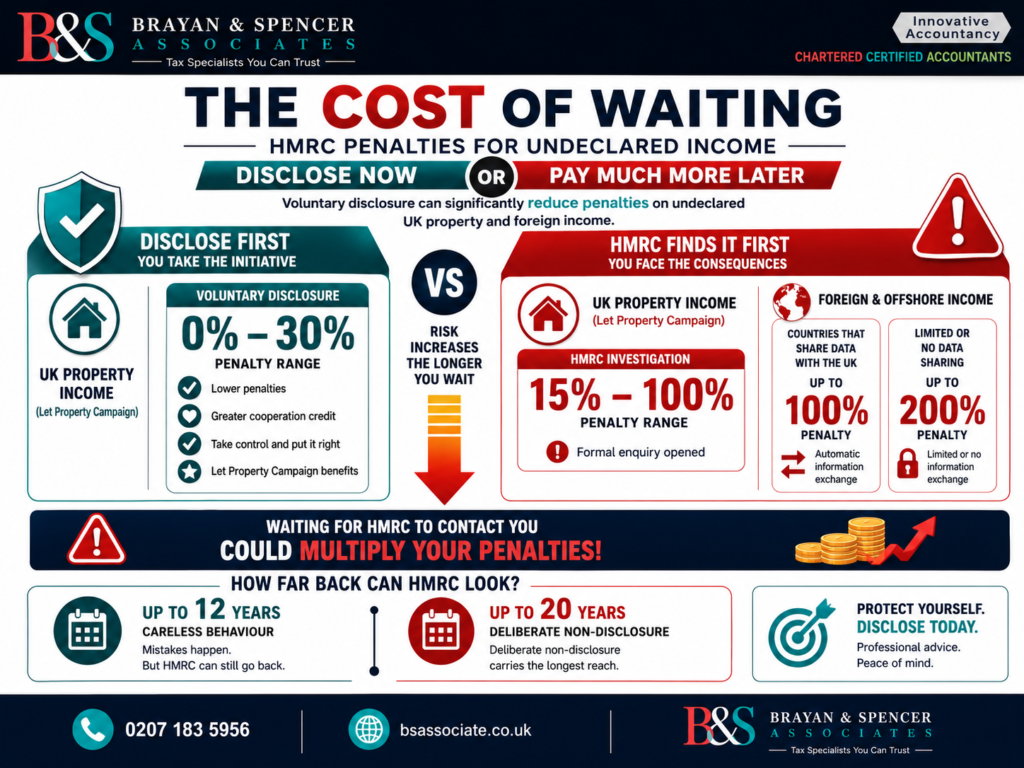
The financial case for responding quickly is stark. Penalties for undeclared income are calculated as a percentage of the tax unpaid, and the rate depends heavily on whether the disclosure was made voluntarily or prompted by HMRC.
For undeclared UK property income under the Let Property Campaign, unprompted voluntary disclosures attract penalties as low as zero percent in some circumstances, rising to a maximum of 30 percent for careless behaviour. If HMRC prompts the disclosure through a formal enquiry, the minimum penalty jumps to 15 percent and can reach 100 percent of the tax owed for deliberate non-compliance.
For offshore and foreign income, the penalties are more severe. HMRC categorises overseas territories into bands. For countries that automatically exchange financial data with the UK, penalties on prompted disclosures can reach 100 percent of the unpaid tax. For territories with limited or no information sharing, the rate can rise to 200 percent. The tax years HMRC can go back and assess also extend further for offshore matters, up to 12 years for careless behaviour and 20 years where HMRC determines the non-disclosure was deliberate.
Acting early, disclosing voluntarily, and presenting your case accurately are the three factors that most influence the final penalty. All three are significantly easier to achieve with professional accounting and tax advisory support.
Common Situations That Lead to HMRC Letters
The accounting and tax advisory team at Brayan & Spencer Associates regularly works with clients in London and across the UK who receive HMRC letters in the following circumstances.
Undeclared rental income from residential property. Many landlords, particularly those who let a property informally or who mistakenly believed their rental income fell below a threshold, discover that HMRC has identified their letting activity through Land Registry data or letting agent reports.
Airbnb and short-term letting income. Since Airbnb began reporting earnings directly to HMRC under DAC7 from January 2024, letters targeting short-term landlords have increased sharply. Even hosts earning under the Rent a Room relief threshold of £7,500 may receive a letter if HMRC’s data suggests higher earnings were not disclosed.
Overseas bank accounts and investments. UK residents are taxable on worldwide income, including interest, dividends, and gains from overseas accounts and investments. If foreign financial institutions have reported your accounts to HMRC and those amounts do not appear in your tax returns, a letter is likely.
Foreign property income. Rental income from property held outside the UK is taxable in the UK for UK residents. Many people are unaware of this or assume their overseas income is covered by local tax paid abroad.
Inheritance and gifts from overseas. In some cases, HMRC letters relate to offshore funds received as inheritance or gifts where the source is unclear from the submitted returns.
How to Respond to an HMRC Letter: Your Options
Once you receive a letter, you have several routes available to you. The right option depends on whether there is genuinely outstanding income, how many tax years are involved, and whether you need to use a formal disclosure channel or a direct response.
Voluntary disclosure via the Let Property Campaign is the appropriate route for most landlords with undeclared rental income. You notify HMRC of your intention to disclose, calculate the tax and interest owed for each outstanding year, and submit a formal disclosure with payment. The window from receiving a disclosure reference number to submitting is typically 90 days.
The Worldwide Disclosure Facility is the correct channel for individuals with offshore income or assets that have not been declared. It operates through HMRC’s online disclosure service and generally produces better penalty outcomes than waiting for HMRC to investigate independently.
Direct written response may be appropriate if you believe HMRC’s letter is based on inaccurate data or if you can demonstrate that all income has been correctly declared. In this case, the response needs to be carefully prepared, factually accurate, and supported by documentation.
In all cases, the way your response is framed directly influences how HMRC categorises the behaviour and sets the penalty band. This is why professional guidance from experienced tax and accounting services in London is not just useful but often the most financially sensible investment you can make.
How Brayan & Spencer Associates Can Help
As specialist tax advisors in London, we provide end-to-end support for clients who have received HMRC letters about undeclared income. Our tax and accounting services in London cover every stage of the process.
We review the letter and the type of enquiry or disclosure it relates to. We assess your full tax position across all relevant years. We calculate the outstanding liability accurately, including interest, to avoid submitting a disclosure that HMRC later challenges. We prepare and submit your voluntary disclosure through the appropriate HMRC channel, whether that is the Let Property Campaign, the Worldwide Disclosure Facility, or a direct response. And once the matter is resolved, we put in place the record-keeping and tax reporting structure to ensure it does not happen again.
We deal with HMRC on your behalf throughout the process. You do not need to speak to HMRC directly at any stage once you have instructed us. Our clients consistently tell us that having a professional handle the communication removes the stress that comes with these situations and produces a better financial outcome than attempting to manage HMRC correspondence alone.
Our accounting services in London are used by landlords, property investors, business owners, and individuals with overseas income who need practical, reliable tax support without jargon or unnecessary complexity.
Do Not Leave It Any Longer
Every week that passes after receiving an HMRC letter narrows your options. Voluntary disclosure reduces penalties. Delay increases them. If HMRC escalates from a nudge letter to a formal enquiry while you are still considering your response, the best penalty rates are no longer available to you.
If you have received a letter from HMRC about undeclared property income, foreign income, or any other potential tax shortfall, the right time to act is now.
Brayan & Spencer Associates provides expert accounting services in London and tax advisory support for individuals and businesses dealing with HMRC enquiries.
📞 Call: 0207 183 5956 🌐 Visit: www.bsassociate.co.uk
We will review your letter, explain your options clearly, and handle everything with HMRC on your behalf. Confidential, professional, and straightforward.
Frequently Asked Questions
Do not ignore it and do not respond without taking professional advice. Read the letter carefully to understand whether it is a nudge letter, a Let Property Campaign notice, or a formal section 9A enquiry. Then contact a qualified tax advisor before submitting any written response to HMRC. The wording of your response influences how HMRC categorises the situation and what penalty band applies.
For careless errors, HMRC can typically go back four years. For offshore income with careless behaviour, this extends to 12 years. Where HMRC determines the non-disclosure was deliberate, it can investigate up to 20 years into the past for both domestic and offshore matters. Acting promptly and voluntarily significantly limits the look-back period in many cases.
Penalties depend on whether the disclosure was unprompted or prompted by HMRC and on the behaviour category. For the Let Property Campaign, unprompted voluntary disclosures can attract penalties of zero to 30 percent of the unpaid tax. If HMRC has already opened an enquiry, prompted disclosure penalties start at 15 percent and can reach 100 percent for deliberate non-compliance.
You can, but it is rarely advisable for anything beyond a very simple correction. The way you frame your response to HMRC has a direct impact on the penalty outcome. An experienced tax advisor in London understands how to present your case accurately, ensure the disclosure is complete, and negotiate on your behalf. Errors or incomplete disclosures can result in significantly higher penalties than a correctly handled professional disclosure.
The Let Property Campaign is HMRC’s voluntary disclosure scheme for residential landlords with undeclared rental income. It has been open since 2013 and remains active in 2026 with no announced end date. It allows landlords to calculate and pay outstanding tax with reduced penalties compared to a formal HMRC investigation. Most landlords who receive a nudge letter about rental income will use this route.