
If you’re a sole trader or landlord in the UK, the shift to making tax digital for income tax self assessment is no longer something to plan for later. It starts on April 6, 2026, and for many people, that deadline has come around faster than expected.
If you’re feeling behind, confused, or unsure where to begin, you’re not alone. A lot of business owners and landlords are in the same position right now. The key thing to understand is this: you don’t need to be perfect before the deadline, but you do need to start taking the right steps.
This guide breaks everything down in simple, practical terms so you can move forward with clarity.
What Is Making Tax Digital for Income Tax?
Making tax digital for income tax is a new system introduced by HMRC to modernise how tax is reported.
Instead of:
- Filing one tax return at the end of the year
You will now:
- Keep your records digitally
- Send updates every 3 months
- Submit a final declaration at the end of the year
This applies to both self-employed individuals and making tax digital for landlords.
Think of it as moving from a once-a-year task to a more regular, organised way of managing your finances.
Who Needs to Act Before April 6, 2026?
You need to act now if:
- You are self employed (sole trader)
- You earn income from property (landlords)
- Your total income is more than £50,000
If this applies to you, then making tax digital for income tax self assessment becomes mandatory from April 6, 2026.
Even if you’re slightly below this threshold, it’s worth preparing early because:
- The threshold drops to £30,000 in 2027
- Then £20,000 in 2028
Why So Many People Feel Unprepared Right Now
Let’s be honest. Most people didn’t ignore MTD on purpose.
Common reasons include:
- It felt too far away
- The rules sounded complicated
- You were busy running your business
- Your current system “worked fine”
But now the deadline is close, and the pressure is real.
The good news is you can still get on track quickly if you focus on the essentials.
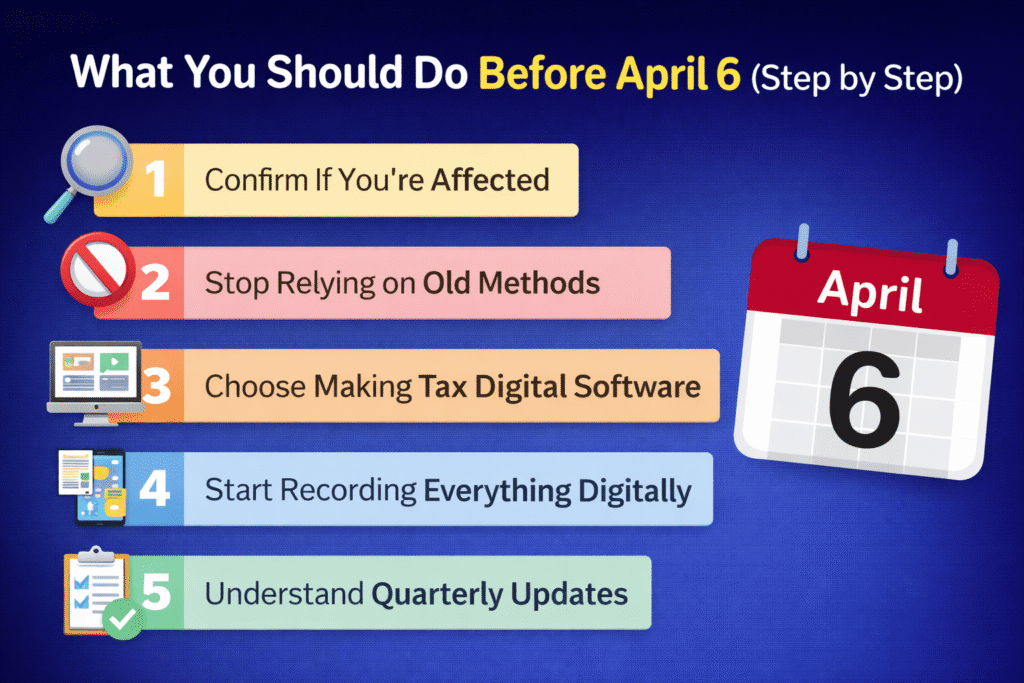
What You Should Do Before April 6 (Step by Step)
1. Check If You’re Affected
Start by confirming your income level from your last tax return.
If you’re over £50,000, you need to act now.
This step avoids unnecessary stress or false assumptions.
2. Move Away from Paper and Spreadsheets
One of the biggest changes is that manual records are no longer enough.
If you currently:
- Keep receipts in a folder
- Update spreadsheets once in a while
- Sort everything at year end
This approach will not work under making tax digital for income tax.
You need a system that is:
- Digital
- Up to date
- Easy to maintain
3. Choose Making Tax Digital Software
To comply, you must use making tax digital software that connects with HMRC.
When choosing software, keep it simple:
- Easy to use
- Tracks income and expenses
- Allows direct submission to HMRC
Don’t spend too long comparing dozens of options. The best software is one you’ll actually use regularly.
4. Start Recording Your Income and Expenses Digitally
This is the most important habit to build.
Make sure you record:
- All income coming in
- All business expenses
- Dates and categories
For landlords, this includes:
- Rental income
- Repairs and maintenance
- Letting agent fees
For sole traders:
- Sales
- Tools and materials
- Travel and running costs
The aim is to avoid missing information later.
5. Understand Quarterly Updates (Without Stress)
One of the biggest worries is the move to quarterly reporting.
Here’s a simple explanation:
You will submit:
- 4 updates during the year
- 1 final declaration
Each update is just a summary of your income and expenses.
It is not as complicated as a full tax return.
If your records are organised, this becomes a routine task.
6. Get Your Current Records in Order
Before April starts, try to:
- Organise your recent transactions
- Separate personal and business finances
- Make sure your numbers are accurate
Starting with clean records will make everything easier going forward.
7. Don’t Rely on the 12 Month Soft Landing
HMRC is offering a 12 month transition period with relaxed penalties.
But this does not mean you can delay everything.
If you ignore MTD now, you’ll likely face:
- Bigger problems later
- More stress
- Possible penalties once the transition ends
Use this time to build good habits.
Common Mistakes to Avoid
As the deadline approaches, avoid these mistakes:
- Waiting until the last minute
- Setting up software but not using it
- Not understanding how updates work
- Assuming your accountant will handle everything
Taking responsibility early will save you time and stress.
A Simple Plan If You Feel Overwhelmed
If everything feels too much, follow this basic plan:
- Day 1: Check if MTD applies to you
- Day 2: Choose your software
- Day 3: Set it up
- Day 4: Start recording transactions
- Day 5: Learn how updates work
You don’t need to do everything perfectly. You just need to start.
How Making Tax Digital Can Help You
Although it feels like extra work at first, making tax digital for income tax has benefits:
- You always know your financial position
- Less stress at tax time
- Fewer errors
- Better control over your business
Once you get used to it, many people find it easier than the old system.
Need Help Understanding Your Next Step?
If you’re unsure about your situation, software, or how making tax digital for landlords or sole traders applies to you, getting the right guidance now can save you time and prevent mistakes later.
Call us at 0207 183 5956 or visit www.bsassociate.co.uk
Final Thoughts
If you’re not ready yet, don’t panic. But don’t ignore it either.
The move to making tax digital for income tax self assessment is a long-term change. The sooner you start, the easier it becomes.
Focus on:
- Getting set up
- Keeping records regularly
- Understanding the basics
Small steps now will prevent bigger problems later.
Frequently Asked Questions (FAQs)
1. What is making tax digital for income tax self assessment?
It is a new HMRC system that requires you to keep digital records and submit updates every quarter instead of filing one annual tax return.
2. Do landlords need to follow MTD rules?
Yes, making tax digital for landlords applies if your rental income contributes to a total income above £50,000.
3. Do I have to use software for MTD?
Yes, you must use making tax digital software that is approved and compatible with HMRC systems.
4. Are quarterly updates the same as tax returns?
No, they are simpler. They are just summaries of your income and expenses, not full tax calculations.
5. What happens if I miss the deadline?
There is a 12-month soft landing period, but you should still aim to comply early to avoid future penalties and stress.
6. Can my accountant handle everything for me?
They can help, but you still need to maintain proper digital records throughout the year.
7. What if my income is below £50,000?
You may not need to comply in 2026, but you will likely be included in later phases as thresholds reduce.