

Author name: Pat Sharma FCA, ACCA

Pat Sharma FCA, ACCA Pat Sharma is a Fellow Chartered Accountant (FCA) and ACCA-qualified tax advisor with over 15 years of experience supporting small businesses, contractors, landlords, and limited companies across London. As the founder of Brayan & Spencer Associates, Pat specialises in proactive tax planning, cloud accounting, and HMRC compliance for UK businesses.

Tax Planning for Landlords with Multiple Properties in London 2026 Guide | B&S Chartered Certified Accountants

Tax Planning for Landlords with Multiple Properties in London: The 2026 MTD Survival Guide 

If you own more than one rental property in London, 2026 brings important tax changes. HMRC has introduced Making Tax Digital for many landlords. Additional property purchases now attract a 5% SDLT surcharge. The proposed High Value Council Tax Surcharge could also affect some London properties from 2028. Understanding these changes now can help you […]
Tax Planning for Landlords with Multiple Properties in London: The 2026 MTD Survival Guide  Read More »

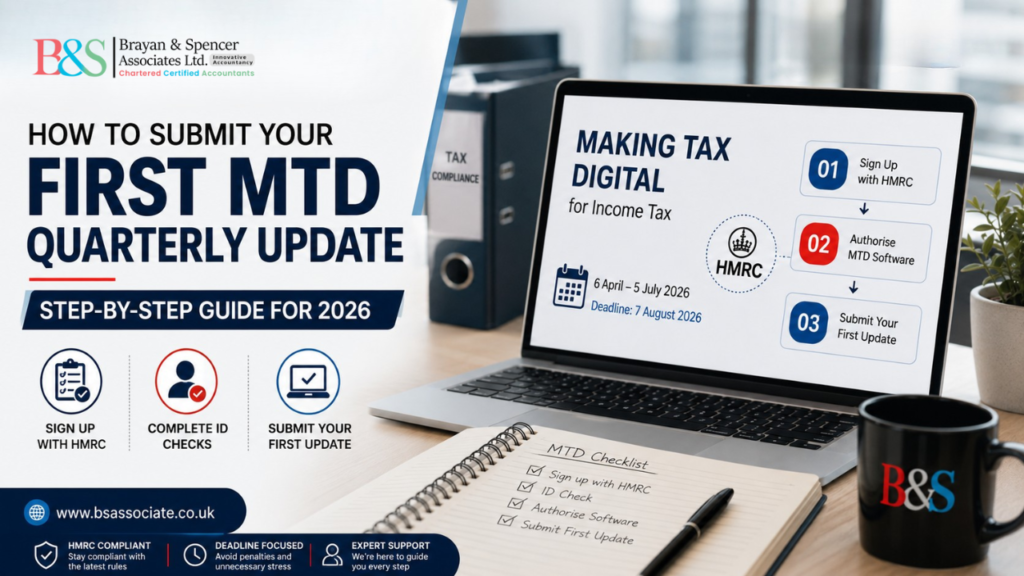
Step-by-step guide to submitting your first MTD quarterly update to HMRC

How to Submit Your First MTD Quarterly Update (Step-by-Step Guide) 

Quick Answer  Your first MTD quarterly update covers 6 April to 5 July 2026 and is due by 7 August 2026, but you cannot submit anything until two earlier steps are done: signing up with HMRC (which has its own eligibility rules beyond the £50,000 income threshold) and authorising MTD-compatible software to connect to your HMRC account.

How to Submit Your First MTD Quarterly Update (Step-by-Step Guide)  Read More »

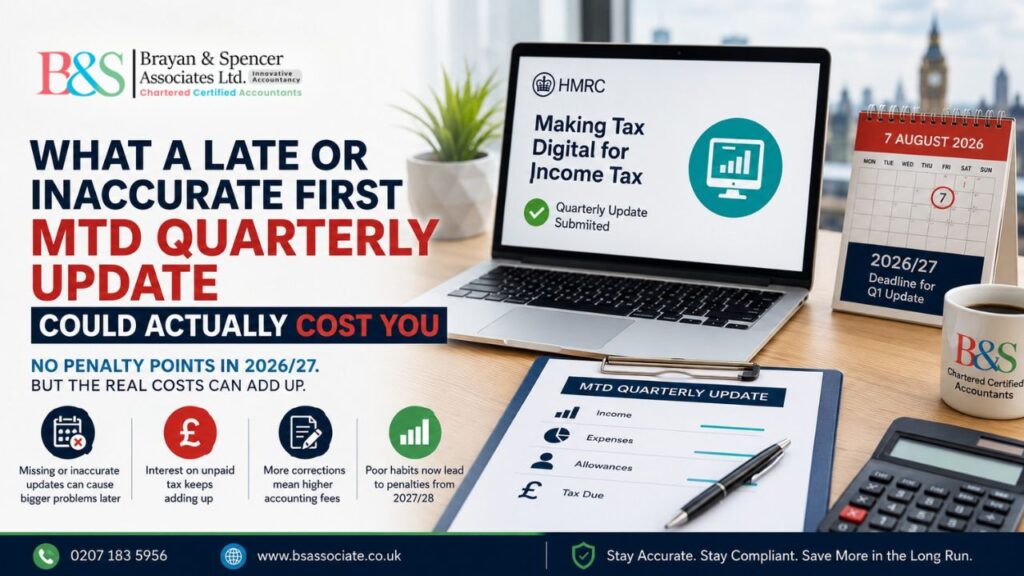
MTD quarterly update cost for London landlords and sole traders

What a Late or Inaccurate First MTD Quarterly Update Could Actually Cost You 

The MTD quarterly update cost isn’t just about penalty points. Most of the conversation around 7 August 2026 focuses on whether people will file on time. Fewer people ask what a rushed, inaccurate, or bodged first submission costs, even inside HMRC’s first-year soft landing. HMRC waives the penalty points. The consequences of bad numbers don’t disappear from them.  For London sole traders and

What a Late or Inaccurate First MTD Quarterly Update Could Actually Cost You  Read More »

MTD Penalties 2026/27 - 5 Key Rules Every Taxpayer Must Know

Making Tax Digital Compliance in 2026/27: Five Penalty Rules You Cannot Ignore 

“There are no penalties in the first year” is the line doing the rounds in every London landlord WhatsApp group and freelancer Slack channel right now. It’s not wrong exactly, but it’s dangerously incomplete. HMRC’s soft landing for Making Tax Digital covers far less than most people assumes, and the gap between what taxpayers think is protected and what’s protected is where penalty

Making Tax Digital Compliance in 2026/27: Five Penalty Rules You Cannot Ignore  Read More »

Making Tax Digital deadline

Half of Small Businesses Are Behind on Making Tax Digital – Are You One of Them? 

The first Making Tax Digital for Income Tax quarterly update is due on 7 August 2026, and by most current estimates, roughly half of the small businesses, sole traders, and landlords who fall within scope aren’t ready to file it. That’s not a small margin. It means a coin-flip chance that a business reading this

Half of Small Businesses Are Behind on Making Tax Digital – Are You One of Them?  Read More »

MTD for Income Tax

MTD for Income Tax: The Essential Quarterly Compliance Checklist for Sole Traders and Landlords in 2026 

Most guides to Making Tax Digital for Income Tax tell you the dates and stop there. What they rarely tell you is what needs to happen inside your business, week by week, so that when 7 August arrives, your quarterly update is a five-minute formality rather than a scramble. That’s the gap this article fills.  If you’re a sole trader or

MTD for Income Tax: The Essential Quarterly Compliance Checklist for Sole Traders and Landlords in 2026  Read More »

MTD Quarterly Update

What Actually Goes into Your MTD Quarterly Update? A Line-by-Line Breakdown Before 7 August 

Your first quarter under Making Tax Digital for Income Tax closed on 5 July. The deadline to submit it is 7 August. So, here’s the question nobody’s answered yet: what actually goes in it?  If you’ve already read about the deadline itself, you know the date. What you probably don’t know is what to type into your software when you sit down to file

What Actually Goes into Your MTD Quarterly Update? A Line-by-Line Breakdown Before 7 August  Read More »

MTD

MTD for Income Tax Phase 2: Why £30,000+ Sole Traders and Landlords Should Start Preparing Now, Not in 2027 

Every piece of Making Tax Digital coverage right now is aimed at one group: sole traders and landlords with qualifying income over £50,000, who just filed their first quarterly update by 7 August 2026. That’s the right story for this month. But it’s created a blind spot for a much larger group who will be mandated into Making Tax Digital

MTD for Income Tax Phase 2: Why £30,000+ Sole Traders and Landlords Should Start Preparing Now, Not in 2027  Read More »

MTD for Income Tax quarterly deadline

Five Weeks to 7 August 2026: What to Actually Do Before Your First MTD Quarterly Update 

Most articles about the 7 August 2026 deadline stop at “here are the dates.” You’ve likely seen that version already, possibly on your own reading list, possibly on this site. What’s missing from almost all of them is the part that determines whether your first submission goes smoothly: the decisions and admin that must happen before 7 August, not on it.  This is that piece. Not another explainer on who

Five Weeks to 7 August 2026: What to Actually Do Before Your First MTD Quarterly Update  Read More »

Employer reviewing HMRC mandatory payrolling of Benefits in Kind guidance for 2027 payroll compliance in the UK.

HMRC Benefits in Kind Changes 2027: What UK Employers Need to Know About Mandatory Payrolling

HMRC is changing how employers report and tax Benefits in Kind (BiKs). From 6 April 2027, mandatory payrolling will replace the traditional reporting process for many employee benefits, requiring employers to report taxable benefits through payroll in real time instead of relying primarily on annual P11D forms.  Although the implementation date has been delayed giving businesses more

HMRC Benefits in Kind Changes 2027: What UK Employers Need to Know About Mandatory Payrolling Read More »

Scroll to Top